
Google coding interview questions: what they test and how to practice
On public, community-kept lists, 52% of the 2,400+ Google coding interview questions are medium difficulty, 26% easy and 22% hard, and arrays, strings and hash maps are the most common topics. In Beta, Tsenta's Interview tab opens nearly every question linked to Google in its own editor, builds a mock of your upcoming Google round and gives feedback after the real one.
Google's hiring page says the process typically takes roughly 6 to 8 weeks, uses the same clear rubrics for every candidate for a role and has no brain teasers. It also says AI tools are not permitted during your interviews, so use Tsenta to practice before your Google round and to get feedback after it.
- 2,400+
- questions linked to Google on public, community-kept lists, about 98% of them open in Tsenta's editor
- 16%
- hard among the 644 questions community lists mark as recently asked at Google, against 23% across Tsenta's coding bank
- 10%
- two pointers problems among the 644 questions community lists mark as recently asked at Google, against 7% across Tsenta's coding bank
- 280
- questions linked only to Google, on no other company's community-kept list
How to practice for your Google interview in Tsenta
- Step 1
Tsenta finds the interview
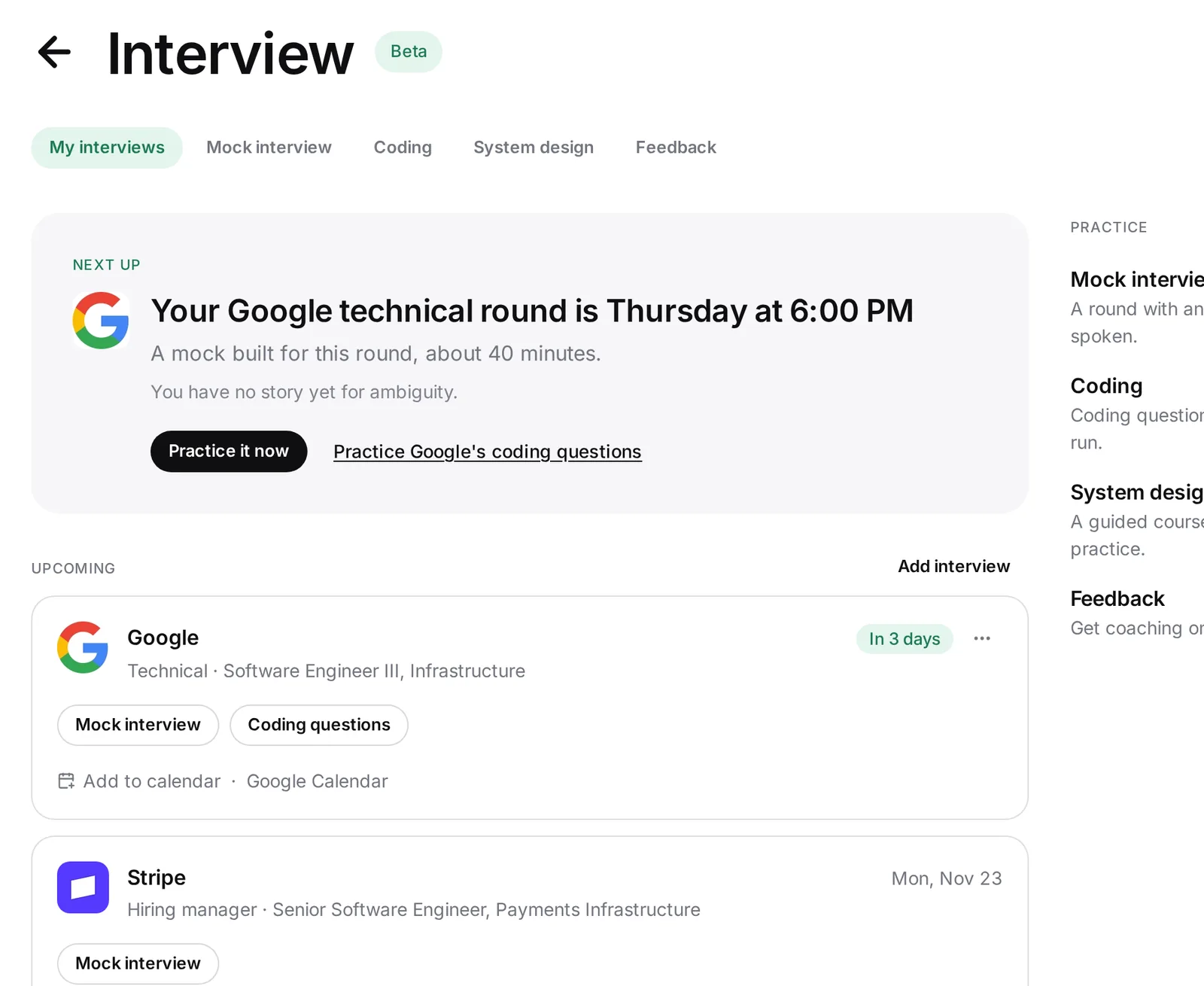
My interviews reads your upcoming Google interview from the job email you connect to Tsenta, with the role, round and day. You can also add it by hand.
- Step 2
Next up shows the round
For a technical round, Next up says when it is, for example “Your Google technical round is Wednesday at 6:00 PM,” with Practice it now. For a software engineering or data science role, or if Tsenta counts you as working in tech, it also links to Google's coding questions.
- Step 3
Filter Coding to Google
The Companies view pins the companies of your upcoming interviews first, and the company chip filters the problems to Google. Google's list is sorted by how often each question is asked, with recently asked ones marked.
- Step 4
Rehearse each round
Press Mock interview on the interview's card. The mock follows the round on the card. It is built from your résumé, your stories and Google's published values, plus the job description when Tsenta has it for the posting. If your loop has a design round, practice it separately in System design.
- Step 5
Get feedback on the real round
Google does not permit AI tools during its interviews, so skip the AI notetaker and write the round down yourself once it ends. Put what you were asked and how you answered in at least six turns labeled Interviewer and Me, and paste it with Add transcript on the interview's card. Tsenta gives feedback on each answer, and Prep for the next round, on the card, sets up a mock of your next Google round built around that feedback.
Google interview process for software engineers, in Google's words
Google's hiring page says the same basics apply “whether you're in for an engineering job or a marketing job.” Its FAQ says the process typically takes roughly 6 to 8 weeks once you've kicked off interviews for a specific role, and a recruiter explains your specific timeline. Neither that page nor Google's interview tips page says how many coding rounds a software engineer has or how long each one runs.
Every candidate for a role is assessed with the same clear rubrics, and the questions are role-related and open-ended, asked “to learn how you solve problems.” Google's tips page adds that it has reintroduced in-person interviews for some roles, often after initial interviews done virtually.
- Assessments
- You may be asked to take the Google Hiring Assessment, “designed to measure workstyle skills required for success in a role with us,” and role-related assessments “like a coding exercise.”
- Recruiter conversations
- Typically one or two shorter calls by phone or video that assess key skills for the role and ask about your preferences, such as location.
- Project work
- For some roles, a small project before interviews, such as a case study or writing or code samples.
- Interviews
- A panel of interviews “either over video or in person with a rotating cast of Googlers.” Google adds, “There aren't any brain teasers either.”
- Decision and offer
- Google reviews your application and interviews together, and your recruiter reaches out if there is an offer. The tips page says a decision can take several weeks.
Coding questions asked in Google interviews, by topic and difficulty
Google's hiring pages give no list of its coding questions. Tsenta's coding bank links 2,400+ questions to Google from public, community-kept lists of the questions companies ask. That is about 7 in 10 of the questions in the bank, so Google's all-time mix sits close to the mix across Tsenta's coding bank. Arrays appear in 56% of Google's questions, strings in 23% and hash maps in 22%, and dynamic programming (17%) and sorting (15%) are the most common patterns.
The recently asked questions on these lists lean easier and toward a few patterns. The lists mark 644 of Google's questions as asked in the last 30 days or three months, as of snapshots from August and October 2026. Of those, 31% are easy and 16% hard, against 24% and 23% across Tsenta's coding bank. Two pointers problems are 10% of them and breadth-first search 9%, against 7% each across Tsenta's coding bank, while greedy falls to 8% from 12%.
- Difficulty, all time
- 26% easy, 52% medium and 22% hard. Across Tsenta's coding bank: 24%, 53% and 23%.
- Difficulty, recent
- 31% easy, 52% medium and 16% hard, out of 644 recent questions.
- Above Tsenta's coding bank
- Matrix problems are 9% of Google's questions against 7% across Tsenta's coding bank. Among recent questions, stack problems are 7% against 5%.
- Overlap with other companies
- 368 of Google's questions (15%) are also on the lists of 10 or more other companies, and 280 are on Google's list alone.
How to prepare for a Google coding interview
Google's tips page says “the interviewer will be looking to see the thought process versus the answer itself.” It adds that many questions leave room for clarification, and that you can take a few moments and “write it out if it helps clarify.” So practice saying your assumptions and approach before you type, and walk an example through your code yourself before you run it. Google also says you are “always welcome to do a time check with your interviewer.”
In Tsenta, you code in Python, JavaScript, TypeScript, Java, C++, C#, Go or Rust, and SQL problems are written in SQL. Run checks your code against the examples, and Submit runs every case, hidden tests included. Debug steps through one example's run line by line in any of the eight languages, with the variables and the call stack.
The Solution tab keeps Tsenta's editorial and a reference solution behind one “Show solution.” The Tsenta assistant in the sidebar reads the problem, your code and your last run, and gives hints before answers.
Google behavioral interview questions and STAR answers
Google's tips page says many questions sound like “Tell me about a time when…” or “How would you approach this situation…?” It suggests the STAR method, which Google spells out as situation, task, activity and result, and says “preparing a broad library of examples is key.” Because “Google loves data,” it offers one equation for an achievement: “Accomplished [X], as measured by [Y], by doing [Z].”
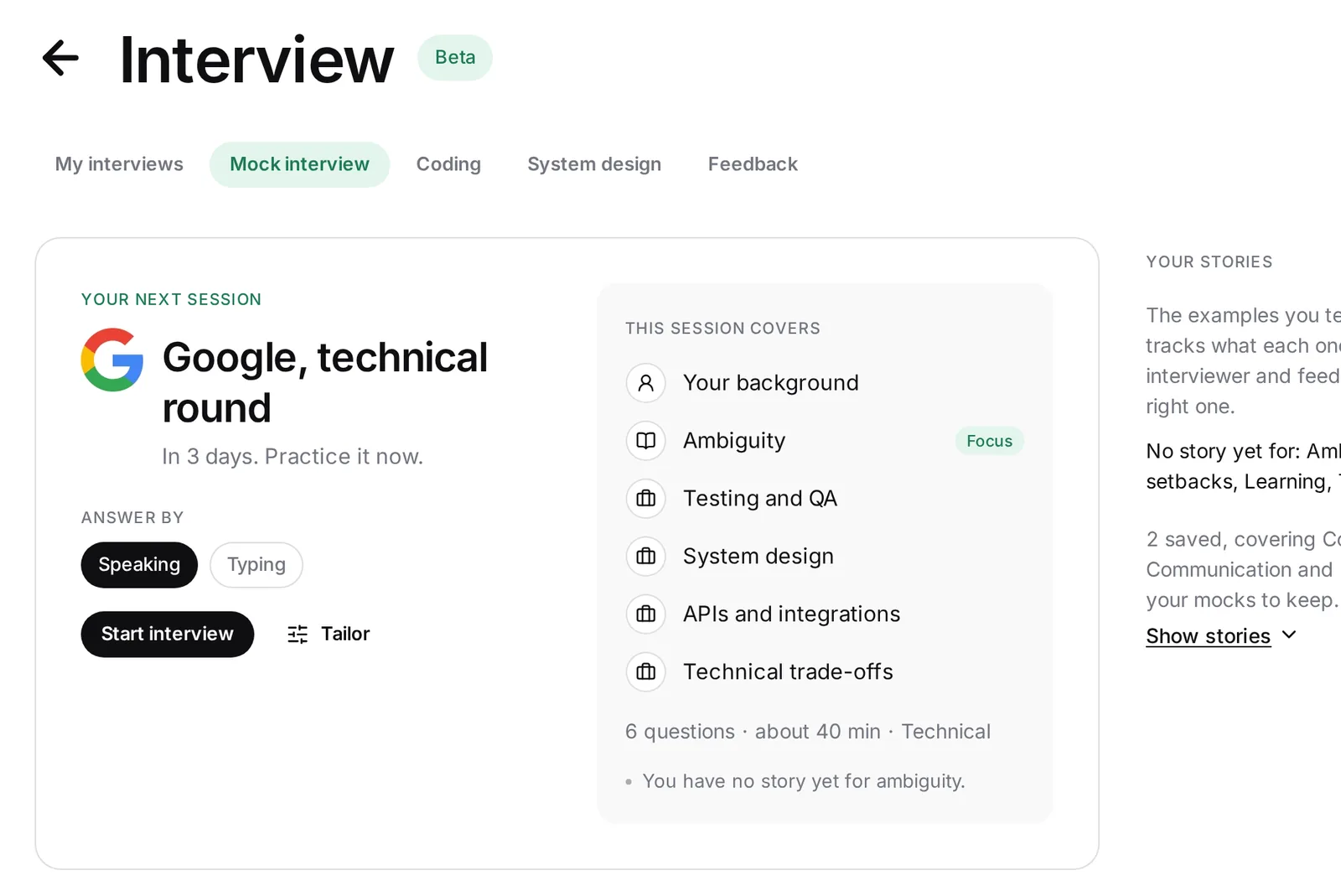
For Google, Tsenta's mock interviewer reads Google's philosophy, “Ten things we know to be true,” such as “Focus on the user and all else will follow” and “Fast is better than slow.” Google is one of 72 companies whose published values Tsenta has. The report marks each STAR part, and a number in the result, as given, given after a follow-up, or missing. A result without a number, the [Y] in Google's equation, gets a tip.
Google's tips page also names ambiguity, working with people and teams, and leadership as themes to prepare. Tailor can set those three as the focus areas of a mock, and Your stories keeps the examples you build for each.
Google mock interview for each round
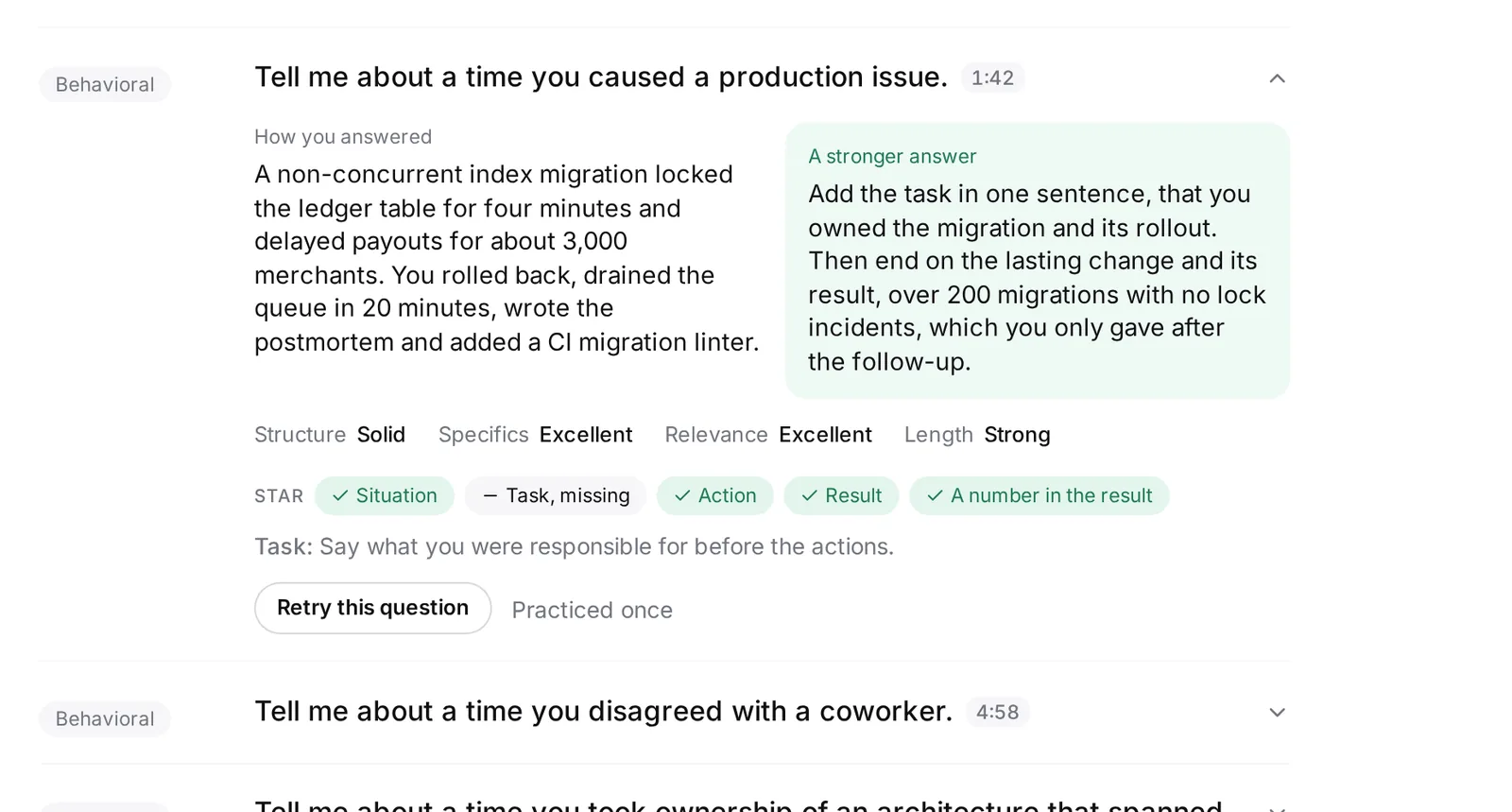
Google's hiring page describes one or two recruiter conversations and then a panel of interviews with a rotating cast of Googlers, and Tsenta has a mock for each kind of round. A recruiter screen mock is 5 questions in about 25 minutes, a technical round 6 in about 40, and a panel or onsite round 7 in about 45 with 2 or 3 fictional panelists. A technical round mock is a spoken or typed interview on topics such as your background, incidents and on-call, and the languages and frameworks you use. Pair it with Google's questions in Coding for the code itself.
Google's hiring page lists a systems design prep video among its resources for software engineers, so ask your recruiter whether your loop includes a design round. Practice that round in Tsenta's System design section, which is separate from mock interviews. Tsenta shows Coding and System design to people in tech roles, based on the roles you search for and apply to, your interviews and your résumé.
System design's Practice library has 100 classic prompts, each opening a 45-minute workspace where your clarifying questions get the numbers a candidate should ask for, with optional twists and a whiteboard. Afterward you check your board against Tsenta's reference design and a 6 to 10 point rubric.
Google's rule on AI tools in interviews, and where Tsenta fits
Google's hiring page says: “We know how great AI can be, trust us. But we want you to engage with the interviewer and our teams authentically and honestly, so AI tools are not permitted to be used during your interviews.” Its tips page says the same: “Google Search and AI are amazing tools, but are not permitted to be used during your interviews.”
Tsenta is not a live interview assistant. It does not join, listen to or record your interviews, and it is built for practice before your Google round and feedback after it. Google's rule covers AI tools in general, Tsenta's assistant included, so keep it closed while you interview.
After the round, Add transcript on the interview's card takes your typed recap and returns feedback only you can see. Each answer is scored on structure, specifics, relevance and length, with a stronger way to say it, and the feedback lists what to prepare before your next round. Practice the next round, in the feedback, then builds a mock interview around it, as Prep for the next round does from the interview's card.
- Google Careers, Our hiring process, checked November 15, 2026
- Google Careers, Interviewing at Google: Best practices, advice, and tips, checked November 15, 2026
- About Google, Ten things we know to be true, checked November 15, 2026
More ways to prepare
- CodingCoding interview practice3,400+ problems from 650+ companies' lists, in eight languages plus SQL, with hidden tests, a debugger in every one of the eight languages and Tsenta's own editorials.See coding practice
- Mock interviewAI mock interviewA practice round built from your real interview, answered out loud or typed, with a report that scores every answer and marks the STAR parts.See mock interviews
- CompanyAmazon coding interviewWhat Amazon publishes about its interviews, how its Leadership Principles shape the behavioral side, and what the questions linked to Amazon on community lists test.Read the Amazon page
- CompanyMeta coding interviewWhat Meta publishes about its interviews and what the questions linked to Meta on community lists test, compared with Tsenta's coding bank.Read the Meta page
Google coding interview questions, answered
Practice for the Google round on your calendar
Connect your job email, and Tsenta finds your Google interview, builds a mock of the round, links Google's coding questions for a technical round in a tech role and gives feedback on your recap.