
An AI mock interview built from the interview you have next
Tsenta's AI mock interview is a practice session with an AI interviewer, built from your upcoming interview's company, role and round, your résumé, your saved stories and the job description when Tsenta has one. You speak your answers by default, and typing is a choice; the interviewer pushes on vague answers, and when you end, a report shows scores, STAR feedback and what to work on next.
Mock interview is in the Interview tab of the Tsenta dashboard on the web, tagged Beta. The agent that applies for you also reads your interviews from the job email you connect, so each one shows up in My interviews, ready to practice. It covers recruiter screens, hiring manager interviews, technical rounds and panels in 20 role families, not only tech.
- 2,000+
- mock interview questions, in role-family packs and a general pack
- 20
- role families with their own question pack, tech and non-tech
- 4
- round types: recruiter screen, hiring manager, technical, and panel or onsite
- 72
- companies whose published values the interviewer knows
How to practice for an interview with AI on Tsenta
- Step 1
Tsenta finds your interview
Tsenta reads upcoming interviews from the job email you connect, or you add one by hand with the company, role, round and a day or time. Each interview gets a card in My interviews with a Mock interview button, and Next up at the top names the one thing to do first, such as Practice it now.
- Step 2
Check the plan, or tailor it
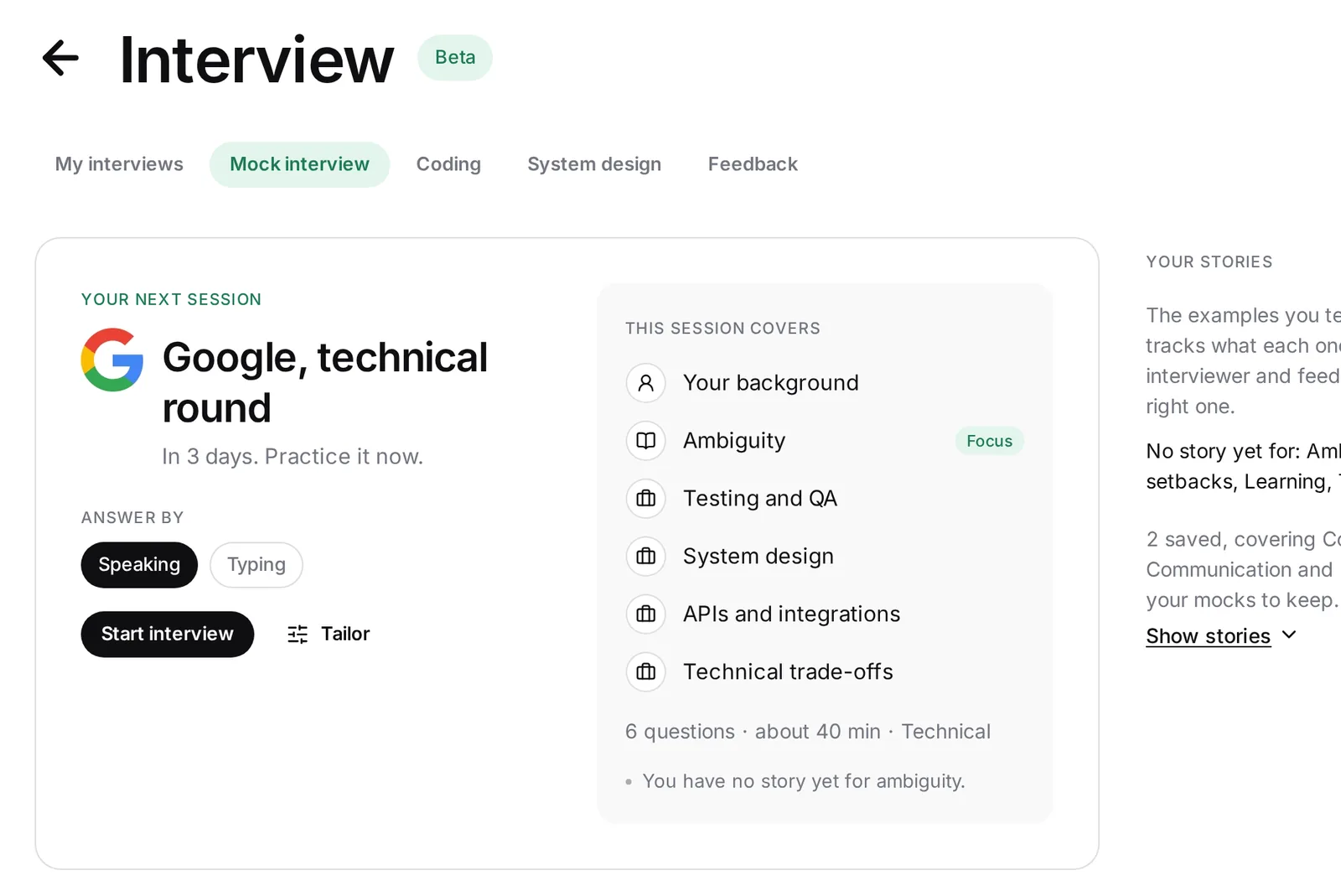
Before you start, the session card shows the plan under This session covers: the topics and competencies, your focus areas, the minutes and the interviewer. Tailor lets you change up to 3 focus areas, the length, the interviewer and the level.
- Step 3
Speak your answers
Speaking is already picked on the session card, so press Start interview and talk. Your words appear in the thread as you say them. Switch to Typing if you would rather write. Questions come one at a time, and the interviewer pushes when an answer leaves out what you did or what came of it.
- Step 4
Read your report
Shortly after you end, the report scores each answer, marks the STAR parts each behavioral answer gave or missed and names what to work on next. Retry this question practices any one question again, or you can start a mock built around the thing to fix.
A mock interview based on the job description, your résumé and your stories
The mock for an interview is built from its company, role and round, your résumé and your saved stories. When the interview is linked to one of your applications, it also uses the job description Tsenta has for the posting. For a Google technical round, the session card's plan covers your background, learning (marked as a focus), incidents and on-call, system design, languages and frameworks, and project planning and estimates. In that example it also notes a gap: "You have no story yet for ambiguity or learning."
For 72 companies, the interviewer also has the company's published values. It does not invent facts about the company.
Apart from the company's published values, the mock reads only your own data. Spoken audio is not stored by Tsenta, and your answers and the report are stored in your account.
Recruiter screen, hiring manager, technical and panel interview practice
A mock started from an interview card uses that interview's round. The round sets how many questions you get and about how long the mock runs.
For people in tech roles, Coding and System design sit beside Mock interview in the same tab, for the parts of a technical loop you practice in an editor or on a whiteboard. A technical round's card gets a Coding questions button only when the company is in Tsenta's coding index. The role must also be in software engineering or data science, or Tsenta must count you as someone in a tech role.
- Recruiter screen (phone screen)
- 5 questions, about 25 minutes.
- Hiring manager interview
- 6 questions, about 40 minutes.
- Technical interview
- 6 questions, about 40 minutes.
- Panel, onsite or final round
- 7 questions, about 45 minutes, asked by 2 or 3 fictional panelists.
- Behavioral
- Pick a round yourself and the hiring manager asks mostly for stories.
- Short version
- 3 questions in 15 minutes, for any round.
AI interview practice out loud, with a live transcript as you talk
A mock is practice for talking, so speaking is how it starts. The interviewer's questions are read aloud, you answer out loud and press Done when you are finished. Your words appear in the thread while you speak, so you can see what the interviewer heard before you hand the answer over. Typing is one tap away on the session card if you would rather write.
The interviewer says it is an AI practice interviewer and asks one question at a time. Mock interview is practice before the real thing, and Tsenta does not join, listen to or record your real interviews.
- Live transcript
- The words you say show up as you say them, then the answer goes to the interviewer when you press Done.
- Typing
- Pick Typing on the session card, or switch mid-interview; the mock runs the same either way.
- No audio kept
- Tsenta keeps the words, not the recording.
An AI interviewer that pushes back instead of nodding along
The interviewer talks like a person, not a script. It opens in its own words, calls you by your first name now and then, and moves on with a short bridge rather than a summary of what you just said. It never praises you, leads you or hints whether you would pass.
A follow-up is one question, usually a sentence or two, anchored in your own words. It digs when an answer is missing your own action, a result or a number, so "we shipped it and it went well" gets a question about what you did or what came of it. Wave a question away and it does not move on: it takes the claim at face value in a few words, then makes the question harder with a real constraint. After two vague replies it moves on.
- Supportive
- For entry level rounds: it follows up on gaps patiently, with no curveballs.
- Demanding
- The usual setting: it pushes on vague or confident claims, asks for numbers and the option you rejected, and plays devil's advocate once.
- Tough
- For senior rounds: curveballs on most questions, and it asks for failure modes as a matter of course.
Behavioral interview practice with STAR method feedback
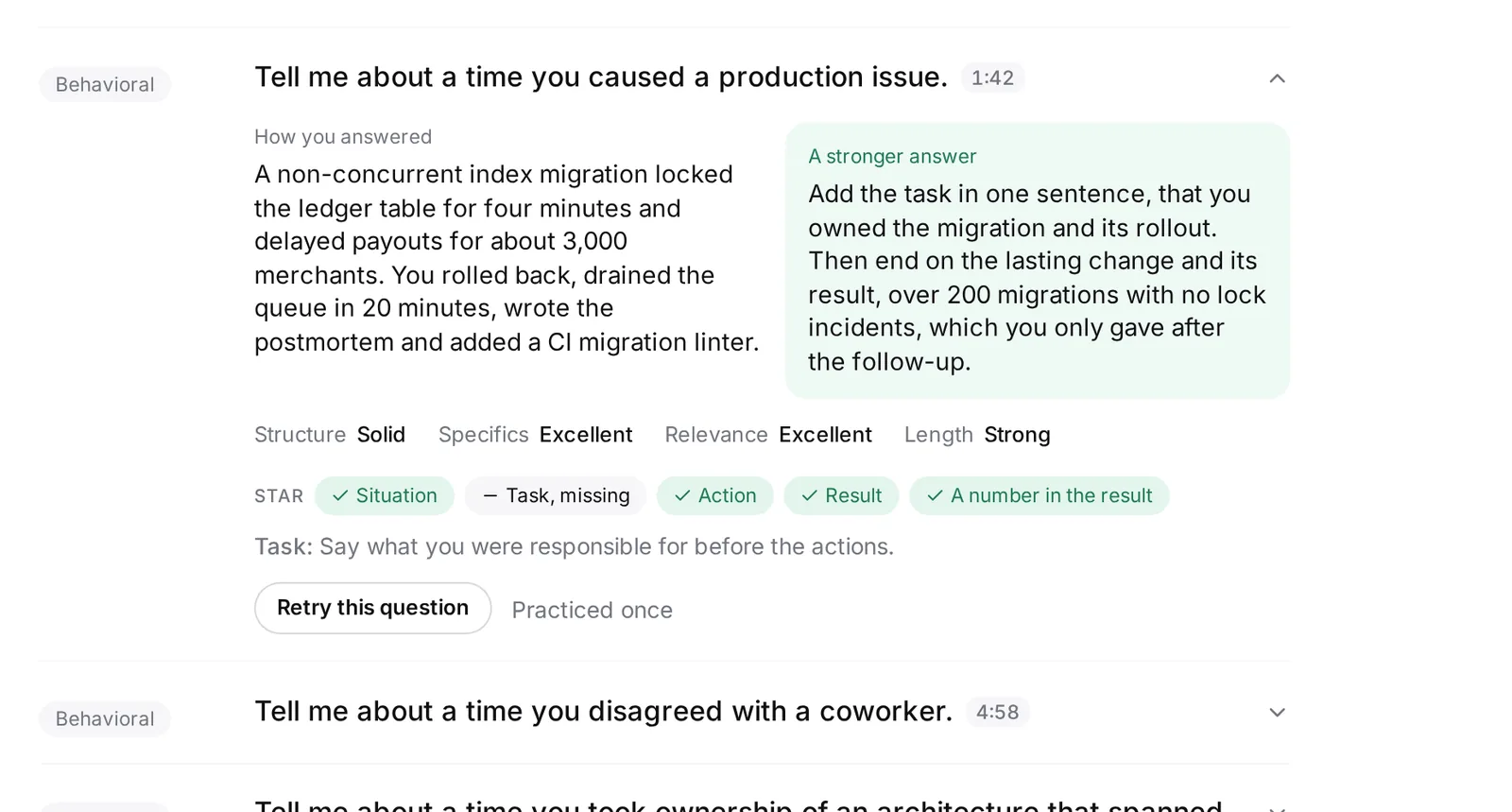
On each behavioral answer, the report checks situation, task, action and result, plus a number in the result. Each part shows as given, given after a follow-up, or missing, with a tip for each part you missed. A summary line counts how many behavioral answers had every STAR part without a follow-up, such as 2 of 3.
Every answer is scored on structure, specifics, relevance and length, and the report sets how you answered next to a stronger answer. Retry this question runs that one question again, so you can fix a missing task without sitting through a whole mock.
Mock interview feedback: what to work on next and a STAR story bank
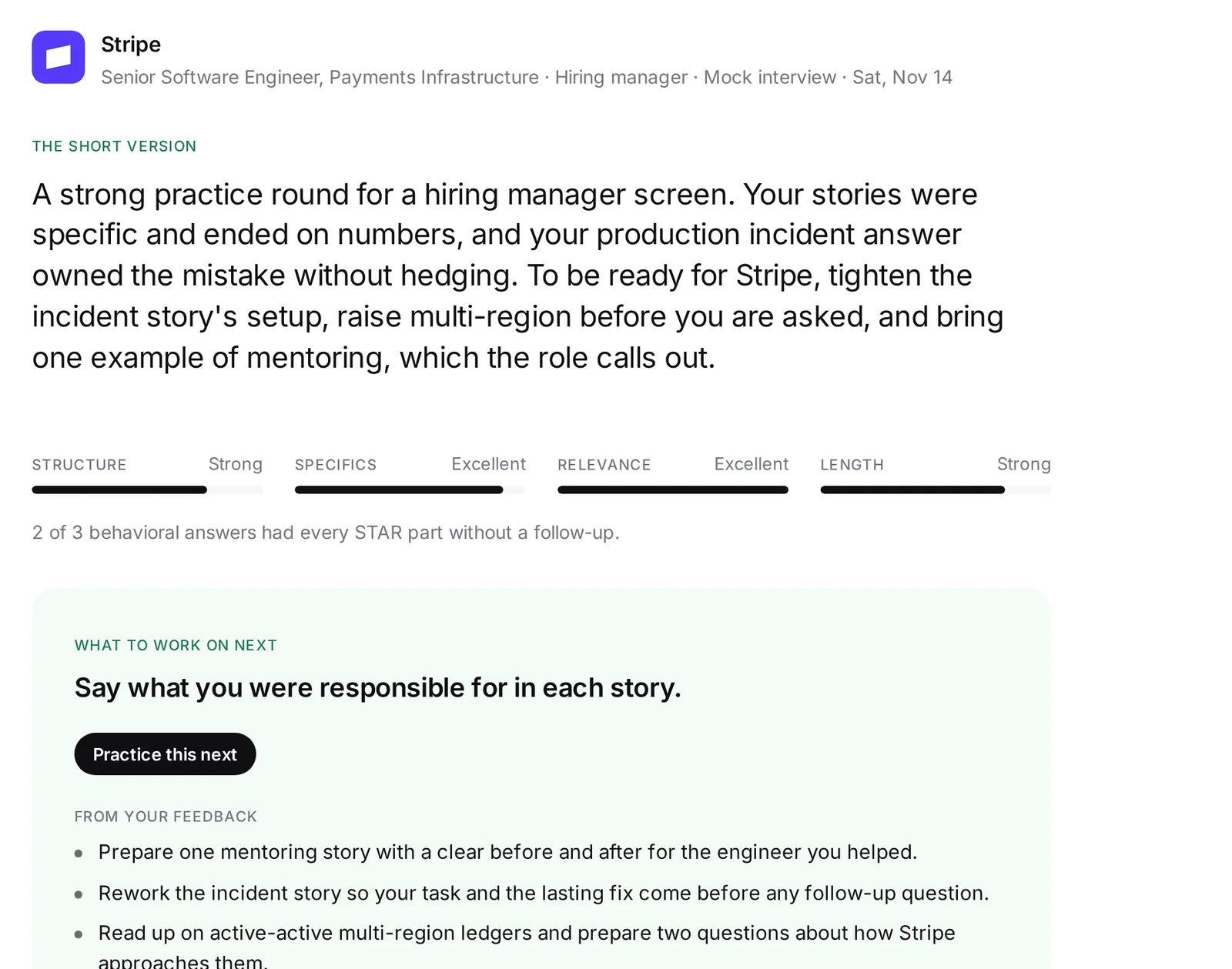
The report opens with the short version of how it went and shows job fit against the job description when Tsenta has one. What to work on next names the first thing to fix, with a mock built around it.
Your stories is a STAR story bank you edit: a title, the situation, task, action and result, and the competencies each story shows. Answers you gave in a mock can be kept as stories, and the report names the story you used and one of yours that fits the question better. The interviewer knows your story titles and favors questions your stories can answer.
After the real interview, add its transcript for feedback on what you actually said. Then Prep for the next round gives you a mock of your next round, built around that feedback.
Mock interview practice for non-tech roles
The question bank holds 2,000+ questions across 20 role-family packs and a general pack. The families are software engineering, data science, product management, design, IT operations, sales, marketing, finance, consulting, operations, human resources, legal, healthcare, education, research, and mechanical, electrical, civil, chemical and industrial engineering.
So a mock for a teaching role draws on the education pack, and a mock for an accountant draws on the finance pack. Mock interview and Feedback are there for every role. Tsenta shows Coding and System design to people in tech roles, based on the roles you search for and apply to, your interviews and your résumé.
Practice the rest of your interview loop
- After the interviewFeedback on a real interviewAdd the transcript from Zoom, Google Meet or a notetaker to get each answer scored, plus delivery numbers and what to prepare before your next round.See interview feedback
- Tech rolesCoding interview practice3,400+ interview problems drawn from public, community-kept lists of the questions 650+ companies ask, in eight languages plus SQL, with Run and Submit.See coding practice
- Tech rolesSystem design interview practiceA 20-lesson animated course, plus 100 classic prompts that open in a 45-minute workspace with a whiteboard and a reference design to check against.See system design practice
AI mock interview questions, answered
Practice your next round before the real one
Tsenta finds the interview in the job email you connect, or you add it, then builds a mock for that company, role and round and shows you what to fix first.