
Meta coding interview questions: what they test and how to practice
Meta's guides say its coding interview questions test computer science fundamentals such as algorithms, data structures, recursion and binary trees, not dynamic programming, and its technical screen has two problems in about 35 minutes. Of the 1,400+ questions linked to Meta on public, community-kept lists, 54% are medium, 31% easy and 15% hard, and Tsenta's Interview tab, in Beta, builds practice around your real Meta round.
Meta's own pages describe a 45-minute technical screen, then a full loop of 4 to 6 interviews covering coding, design and behavioral. Some roles now get an AI assistant inside CoderPad, but Meta authorizes no outside AI tools, so Tsenta stays with your prep before the round and your review after it.
- 1,400+
- questions linked to Meta on public, community-kept lists, about 98% of them open in Tsenta's editor
- 31%
- easy on Meta's community-kept list, against 24% across Tsenta's coding bank, with 15% hard against 23%
- 10%
- hard among the 260 questions the lists mark as recently asked at Meta, against 23% across Tsenta's coding bank
- 15%
- two pointers problems among the 260 questions marked recently asked, against 7% across Tsenta's coding bank
How to practice for your Meta interview in Tsenta
- Step 1
Tsenta finds your Meta interview
My interviews reads your Meta screen or full loop from the job email you connect to Tsenta, with the role, the round and when it is. You can also add an interview by hand.
- Step 2
Next up points at Meta's questions
Next up names your soonest Meta round and when it is, with Practice it now. For a technical round in a software engineering or data science role, a link to Meta's coding questions sits beside it, and the interview's card has a Coding questions button. Both also appear in other roles when Tsenta counts you as being in tech.
- Step 3
Work Meta's list in Coding
The Companies view pins the companies of your upcoming interviews first, and the Meta company chip filters the problems to Meta's. Meta's list is sorted by how often each question is asked, with recently asked ones marked.
- Step 4
Rehearse the conversations
Press Mock interview on the card for a mock of that round, built from your résumé, your stories, Meta's core values and the job description when Tsenta has it for the posting. If your loop has a design interview, add timed prompts from System design, which shows for people in tech roles.
- Step 5
Get feedback after each round
After a round, add its transcript from the interview's card or in Feedback in your Tsenta dashboard, and Tsenta scores each answer. Prep for the next round then builds a mock of your next round around that feedback.
Meta interview process for software engineers, in Meta's words
Meta's hiring page says the process “typically consists of a recruiter conversation, initial screening and a full loop interview,” and usually takes about 2 to 3 months. Depending on the role, it may include “writing code, solving algorithms or creating a case study.” Meta says your recruiter is your best point of contact for questions about your interview format, and candidates can find role-specific prep guides in their Career Profile.
Meta's software engineering prep pages link two guides, one for the technical screen and one for the full loop. Both say the coding interviewer assesses the same four focus areas, and the full loop guide puts it plainly: “Your coding interview should be a conversation, so don't forget to ask questions.”
- Technical screen
- Meta's page calls it “a 45-minute conversation with an engineer.” The guide splits it into introductions (5 minutes), coding (35 minutes, two problems) and your questions (5 minutes). You code in a collaborative editor such as CoderPad by phone or video, or on a whiteboard in person.
- Full loop
- 4 to 6 interviews of 45 minutes each, covering coding, design and behavioral, each with a few minutes at the end for your questions.
- Coding focus areas
- Communication, problem solving, coding and verification: asking for requirements, comparing solutions and their time and space complexity, turning a solution into organized code, and testing it or arguing why it is correct.
- Design
- A 45-minute systems design or product architectural design interview, depending on the position. Meta asks you to check with your recruiter which one to prepare for.
- Behavioral
- A 45-minute conversation about your background, what you are passionate about in tech and the impact you want to make.
What Meta coding interview questions test
Meta publishes no list of the technical interview questions it asks, only practice links and a sample study list in its technical screen guide. Tsenta's coding bank links 1,400+ questions to Meta from public, community-kept lists of the questions companies ask. Meta's list leans easier: 31% easy and 15% hard, against 24% and 23% across Tsenta's coding bank of 3,400+ problems. Arrays appear in 53% of Meta's list, strings in 22% and hash maps in 21%, and trees (9%), depth-first search (11%) and breadth-first search (9%) top the 7%, 9% and 7% across Tsenta's coding bank.
The recent questions lean easier still and toward a few techniques. Of the 260 questions the lists mark as asked in the last 30 days or three months, as of snapshots from August and October 2026, 36% are easy, 55% medium and only 10% hard. Two pointers problems are 15% of them, against 7% across Tsenta's coding bank, with binary search at 12% against 9%, sliding window 7% against 4% and stack problems 9% against 5%.
Meta's full loop guide says, “We do not ask dynamic programming questions,” yet dynamic programming is a tag on 16% of Meta's list and 13% of the recent ones. Where the lists and Meta's guide differ, go with the guide, and spend that time on the data structures it names: arrays, stacks and queues, hash tables, trees, graphs and heaps.
- Recent standouts
- Linked lists are 6% of the questions the lists mark as recent for Meta, against 2% across Tsenta's coding bank, and recursion 5% against 1%.
- Less common on Meta's list
- Greedy problems are 9% of Meta's list, against 12% across Tsenta's coding bank.
- Overlap with other companies
- On the community-kept lists, 45 of Meta's questions appear on no other company's list, and 352 (24%) are also on the lists of 10 or more other companies.
- SQL
- SQL problems are 6% of Meta's list, against 5% across Tsenta's coding bank.
How to prepare for a Meta coding interview
Meta's full loop guide says the interviewer will not compile your code, so minor mistakes are not a worry, and that catching your own bugs is a positive sign. It suggests writing code without running it, in a plain text editor with no compiler, linter, syntax highlighting or autocomplete, talking through the problem before you code, and choosing breadth over depth. The technical screen guide suggests solving medium and hard problems in less than 15 minutes each in practice, says Meta won't ask a “puzzle” question, and describes three kinds of problem you may get.
In Tsenta, write the whole solution and walk an example through it by hand before you press Run, which checks the examples, then Submit to run every case, hidden tests included. Debug steps through one example's run line by line in any of the eight languages, forward and back, with the variables and the call stack, so you can check the hand trace Meta's verification focus area calls for. The Solution tab keeps Tsenta's editorial and a reference solution behind one “Show solution.” The Tsenta assistant in the sidebar reads the problem, your code and your last run, and gives hints before answers.
- A second pass
- Your interviewer may let you solve a problem any way you want, then add limits on running time or space and ask you to solve it again.
- Parsing
- You might parse a data format or a mini language, which shows you can keep several states in your head.
- A library function
- You might be asked to implement a well-known library function, to show you know how things work under the hood.
- Habits Meta asks for
- Meta's screen guide says to ask yourself whether you would approve your solution as part of your codebase, and to tell the interviewer if you have seen a problem before.
Meta behavioral interview questions and STAR answers
Meta's full loop guide says the behavioral interviewer assesses five focus areas: resolving conflict, growing continuously, embracing ambiguity, driving results and communicating effectively. It suggests outlining 2 or 3 major projects ahead of time and organizing answers with the STAR method around a tangible, quantifiable result. It also asks for concrete examples, because the interviewer will redirect a theoretical answer.
The guide also asks you to review Meta's core values. Tsenta's mock interviewer reads the same six for a Meta round: Move fast, Build awesome things, Be direct and respect your colleagues, Focus on long-term impact, Live in the future, and Meta, Metamates, me. The mock also reads your résumé, your saved stories and the job description when Tsenta has it for the posting.
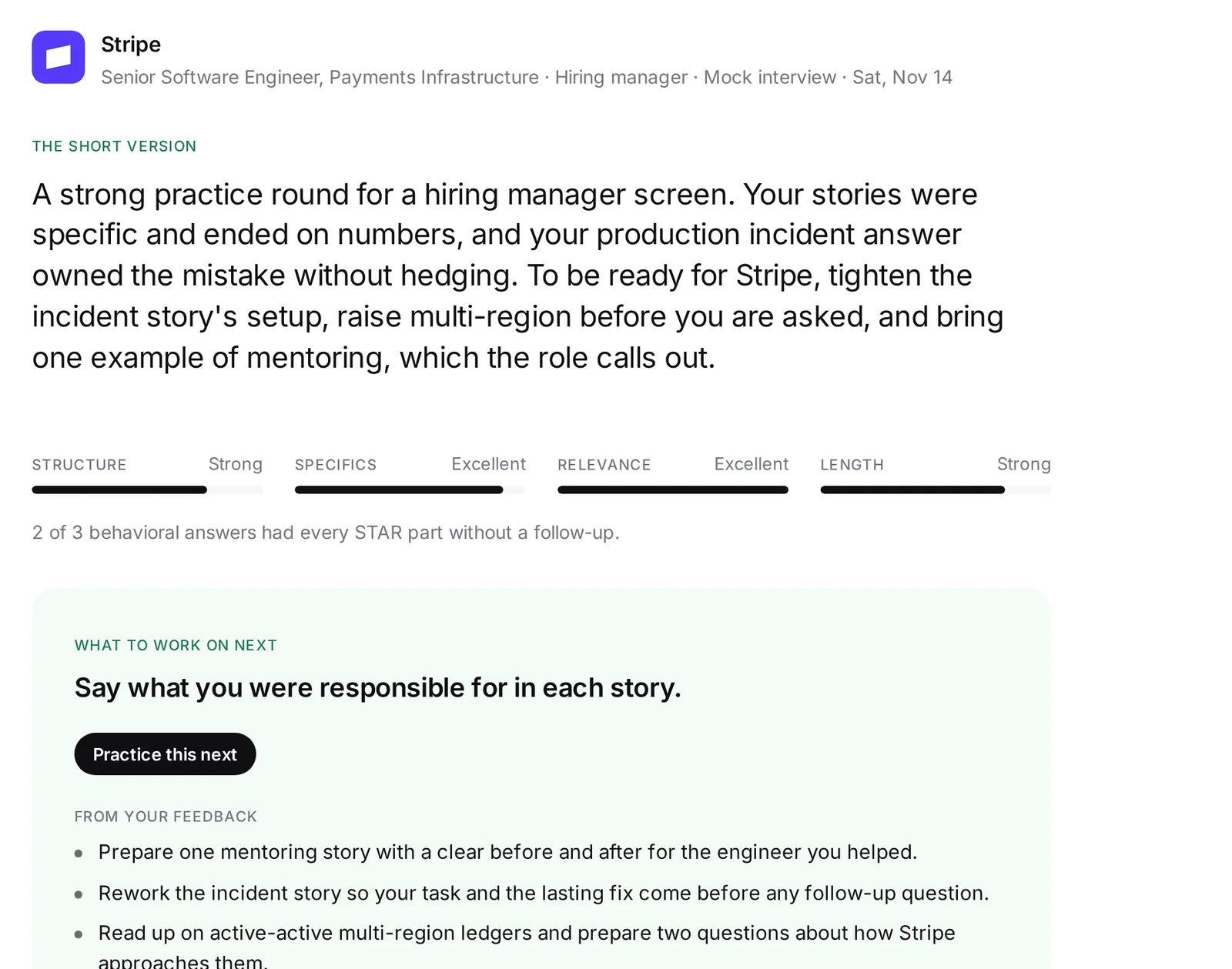
Tsenta's mock interviewer follows up when an answer leaves out your own action, a result or a number, the parts Meta's STAR advice asks for. The report then marks each STAR part, and a number in the result, as given, given after a follow-up, or missing, with a tip for each missing part. Tailor can point a mock at up to 3 focus areas, such as conflict, ambiguity and learning. Your stories keeps the 2 or 3 projects you outline as STAR stories, so the interviewer favors questions they can answer.
Meta mock interview and system design practice for the full loop
Tsenta's mocks rehearse the conversations in Meta's process, not the code. A recruiter screen mock is 5 questions in about 25 minutes. A panel or onsite mock is 7 questions in about 45 minutes with 2 or 3 fictional panelists, about the length of one Meta loop interview. A technical round mock is 6 questions in about 40 minutes, spoken by default or typed, so pair it with Meta's questions in Coding for the code itself.
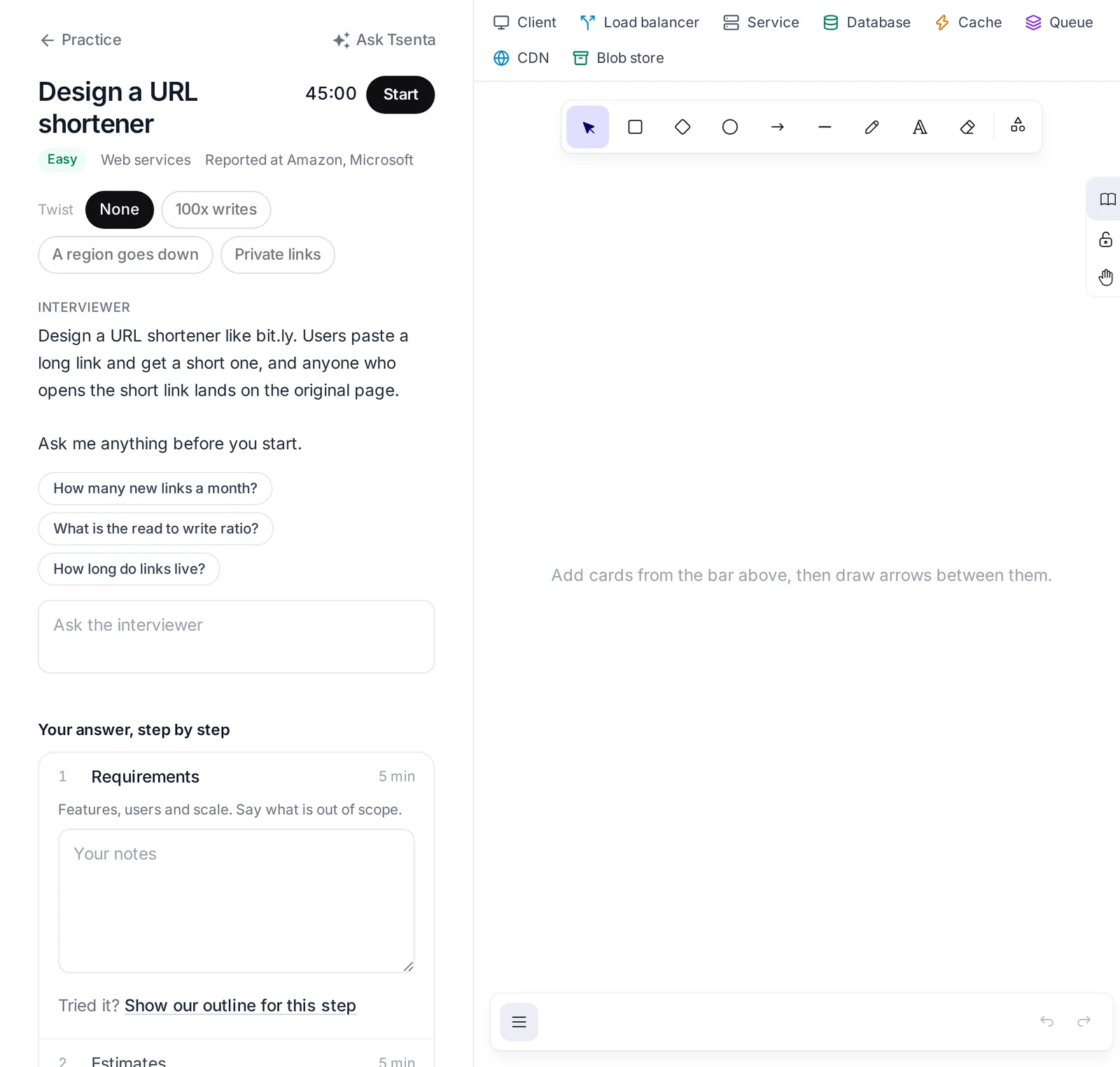
Meta's full loop guide lists “Design a URL shortener” among its example system design questions and suggests answering a few practice questions on paper in roughly 30 minutes each, starting from the requirements. System design, for people in tech roles, has 100 classic prompts, including a URL shortener, a news feed and a chat app. Each opens a 45-minute workspace with an interviewer that answers your clarifying questions with the numbers you should ask for, optional twists such as a region going down, and a whiteboard. The review sets Tsenta's reference design beside your board, with a 6 to 10 point rubric to check yourself against.
Meta's AI coding interview and its rule on outside AI tools
Meta's hiring page says select roles now include an authorized AI assistant within CoderPad during technical interviews, and “Candidates are expected to use this AI assistant as part of the interview.” You pick the model, design interviews use the same assistant, and Meta's AI-Native Coding Interview supports Python, Java, TypeScript, C++, C#, Kotlin, Swift, Rust and Go. To prepare, Meta points to a practice session in your Career Profile, in the same tool it uses for the interview, and to getting comfortable “reading, debugging, and building on existing code.”
Meta's hiring page also says, “No outside AI tools or assistance are authorized,” and “only the tools available within the interview environment may be used.” Its interview guides add, “we ask that you not use any unauthorized outside assistance during interviews,” which they say includes consulting external resources, help from others and AI tools. They also ask you to turn off video filters, blurred backgrounds included. Tsenta is built for practice before your Meta interview and feedback after it: it does not join, listen to or record interviews, and it does not recreate Meta's interview environment.
After the round, add the transcript with Add transcript on the interview's card, or in Feedback in your Tsenta dashboard, and Tsenta shows feedback only you can see. Each answer is scored on structure, specifics, relevance and length, with a stronger way to say it. Because Meta does not authorize outside AI tools in its interviews, do not run an AI notetaker in a Meta round. A recap you type afterward, with at least six turns labeled Interviewer and Me, works instead.
- Meta Careers, Meta Jobs Hiring Process, checked November 15, 2026
- Meta Careers, Preparing for Your Technical Screen, and the Meta Technical Screen Guide it links, checked November 15, 2026
- Meta Careers, Preparing for Your Full Loop Interview at Meta, and the Meta Full Loop Interview Guide it links, checked November 15, 2026
- Meta Careers, Work Culture at Meta (core values), checked November 15, 2026
More ways to prepare
- CodingCoding interview practice3,400+ problems from 650+ companies' lists, in eight languages plus SQL, with hidden tests, a debugger in every one of the eight languages and Tsenta's own editorials.See coding practice
- Mock interviewAI mock interviewA practice round built from your real interview, answered out loud or typed, with a report that scores every answer and marks the STAR parts.See mock interviews
- CompanyGoogle coding interviewWhat Google publishes about its interviews, its rule on AI tools, and what the questions on its list test.Read the Google page
- CompanyMicrosoft coding interviewWhat Microsoft publishes about its interviews and what the questions on its list test, compared with Tsenta's coding bank.Read the Microsoft page
Meta coding interview questions, answered
Get ready for your Meta screen or full loop
Tsenta finds your Meta interview in your job email, builds a mock of the round, links a technical round in a tech role to Meta's coding questions, and gives feedback once you add the transcript.