
Microsoft coding interview questions: topics, difficulty and the 45-minute round
Of the 1,400+ Microsoft coding interview questions on public, community-kept lists, 55% are medium and 17% are hard, and arrays, strings and hash maps are the most common topics. Microsoft's careers site says a technical round is a short 45 minutes in a tool that runs your code, where you code in a language you are strong in and test your own solution.
Interview prep is in Beta in the Tsenta dashboard on the web, next to the agent that applies to jobs for you. Tsenta reads your Microsoft interview from your job email and builds a mock interview for that round from the role, your résumé and Microsoft's published values. For people in tech roles, Coding opens about 98% of the questions that public, community-kept lists link to Microsoft, in Tsenta's own editor with runnable tests.
- 1,400+
- questions linked to Microsoft on public, community-kept lists, about 98% of them open in Tsenta's editor
- 55%
- of Microsoft's listed questions are medium, with 17% hard against 23% across Tsenta's coding bank
- 13%
- of the questions marked recently asked at Microsoft are two pointers problems, against 7% across Tsenta's coding bank
- 45 min
- a technical round, per Microsoft's Technical interviewing page
How to prepare for a Microsoft interview in Tsenta
- Step 1
Let Tsenta find the interview
Tsenta reads your Microsoft interview from your job email and shows it in My interviews with the role, the round and when, or you add it by hand. Before it, the card offers Mock interview. Microsoft is one of the companies Tsenta has coding questions for, so a technical round in a software engineering or data science role, or for someone Tsenta counts as in tech, also gets Coding questions.
- Step 2
Start from Next up
When your Microsoft round is the next thing coming up, Next up at the top of My interviews names it with Practice it now, which opens a mock built for it. If your soonest technical round is at Microsoft and gets Coding questions, Next up in Coding points at Microsoft's questions.
- Step 3
Work through Microsoft's questions
In Coding, the Companies view pins the companies of your upcoming interviews first, and Microsoft's list there is sorted by how often each question is asked, with recently asked ones marked. In Problems, the Microsoft company chip filters the problems to Microsoft's, and topic and pattern filters such as linked lists or two pointers narrow them further.
- Step 4
Run a Microsoft mock interview for the round
Start a mock interview for the round you have: a recruiter screen, a hiring manager round, a technical round (6 questions, about 40 minutes), or a panel with 2 or 3 fictional panelists. Answer by typing or speaking, and practice the code itself in Coding. If the role has a design round, also work a timed prompt in System design and check your board against its rubric yourself.
- Step 5
Get feedback on the real round
After the interview, add its transcript or a written recap labeled Interviewer and Me, and Tsenta scores each answer and lists what to prepare before your next round. Microsoft says some teams ask candidates to sign an NDA before interviews, so check what yours allows before you share anything.
The Microsoft software engineer interview process, in Microsoft's words
Microsoft's How we hire page says most interviews include 2 to 4 conversations with potential teammates and cross-functional colleagues, each lasting up to an hour, over the phone, on Microsoft Teams or in person. It describes structured interviews with a consistent framework that evaluate real skills against the role's requirements. In some cases a team holds a brief screening conversation first, and for some roles you may be asked to write code.
Its Technical interviewing page says an engineering interview evaluates problem solving, design, coding and testing. It calls the technical round a short 45-minute round, so managing your time matters, and asks you to ask clarifying questions and come up with a plan before you implement. The Interview tips page adds that you should state your assumptions and talk through your approach.
On coding, the page says you will code only in the language you are strong in, without pseudocode, in a third-party coding tool where you can run and compile your code. It asks for clean, concise code with no bugs and says: "Practice, practice, practice."
- Algorithms
- Know the details of at least one n log n sorting algorithm, preferably two, such as quicksort and merge sort, and be ready to explain your algorithm's big O. Recursion can be a common pattern for some types of questions.
- Data structures
- Arrays and strings, queues and lists, linked lists, trees and tries, hash maps and hash sets, and graphs, with when to use each and their pros and cons.
- Testing
- Microsoft engineers test their own and their teammates' code, so expect to test your solution before you say done and to point out boundaries, error conditions and corner cases.
Microsoft technical interview questions by topic and difficulty
Public, community-kept lists of the questions companies ask link 1,400+ questions to Microsoft. All time, they are 28% easy, 55% medium and 17% hard, against 24%, 53% and 23% across Tsenta's coding bank, so Microsoft's lists run a little easier than average. The roughly 280 the lists mark as recently asked, in their 30-day or three-month windows from snapshots taken in August and October 2026, are 35% easy, 53% medium and 13% hard.
On these lists, arrays (54%), strings (23%) and hash maps (21%) lead, close to their shares across Tsenta's coding bank, and dynamic programming (17%) and sorting (15%) are the most common techniques. The recently asked ones differ more: two pointers problems are 13% of them against 7% across Tsenta's coding bank, stacks 9% against 5%, and linked lists 6% against 2%. Linked lists are also on the list of data structures Microsoft's own page says come up often.
All time, depth-first search (11%) and breadth-first search (9%) each run 2 points above their shares across Tsenta's coding bank. On these lists, 363 of Microsoft's questions (25%) are also on the lists of 10 or more other companies, so practice on them carries over. Another 49 are on Microsoft's list and no other company's.
How to practice for Microsoft's 45-minute coding round
Microsoft's round uses a tool that runs and compiles your code, so practice where your code runs too. In Tsenta's Coding section you write in Python, JavaScript, TypeScript, Java, C++, C#, Go or Rust, with SQL problems in SQL. Press Run to check the examples, then Submit to run every case, hidden tests included. Each case comes back accepted, wrong answer, runtime error, compile error, time limit or memory limit.
Microsoft expects you to test your own solution, so walk through your corner cases out loud before you press Submit, then let the hidden tests show what you missed. When a case fails, Debug steps through one example's run line by line in any of the eight languages, forward and back, with breakpoints, the variables and the call stack. The Tsenta assistant in the sidebar reads the problem, your code and your last run, and gives hints before answers.
Then open the Solution tab to check your big O against Tsenta's editorial, which gives the approach, the key idea, and the time and space complexity. Your recent submits are saved with their code under Submissions, so you can load an earlier attempt back into the editor.
Microsoft's rule on AI tools and AI-assisted coding interviews
Microsoft's Candidate Code of Conduct, on its How we hire page, says: "We encourage candidates to use AI tools responsibly and ethically during preparation, as long as it reflects their true capabilities. During assessments and interviews, candidates should demonstrate their own skills without outside assistance unless explicitly permitted." It also expects candidates to represent themselves honestly at every stage, from résumés to interviews.
The Microsoft hiring pages we checked on November 15, 2026 describe no AI-assisted coding round, so unless you are told a round allows AI, plan to write and test every solution yourself. Tsenta is built for the preparation side of that line, with practice before the interview and feedback after it. It does not join, listen to or record your interviews.
Microsoft behavioral mock interview with STAR(R) and Microsoft's values
Microsoft's Interview tips page recommends the STAR(R) model: situation, task, action, result and reflection. It says the interview process focuses on Microsoft's culture, which it names as the values and cultural attributes below plus manager expectations. It asks you to prepare specific examples of the situation, what you did, the outcome and what you learned.
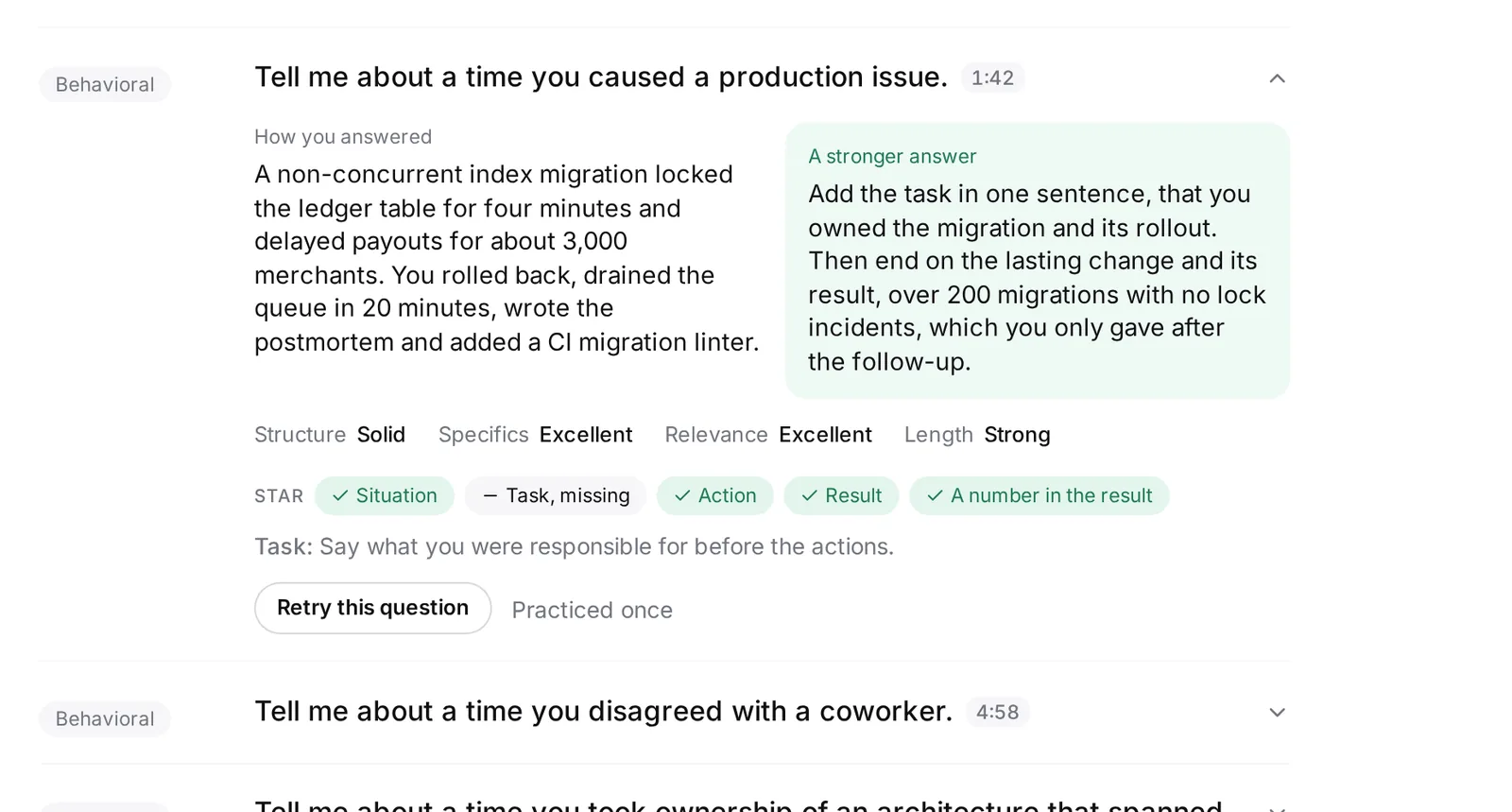
For a Microsoft round, Tsenta's mock interviewer works from the values below, the role, your résumé and your saved stories, and from the job description when Tsenta has it for the posting. Questions come one at a time, and when an answer leaves out what you did yourself, the result or a number, the interviewer asks a follow-up. The report then shows which STAR parts you gave on your own, gave only after a follow-up, or missed, including a number in the result, with a tip for each gap. Reflection is not one of the parts it marks, so close each story with what you learned.
- Respect
- The thoughts, feelings and backgrounds of others are as important as your own.
- Integrity
- Be honest, ethical and trustworthy.
- Accountability
- Accept full responsibility for your decisions, actions and results.
- Growth mindset
- Potential is nurtured, not predetermined. Stay curious, take smart risks and learn from mistakes.
- Customer obsessed
- Understand customers with a beginner's mind and build solutions with them for their real challenges.
- Diverse and inclusive
- Seek out different backgrounds and perspectives so everyone can contribute.
- One Microsoft
- Work as one company through mentorship, collaboration and shared accountability. One person's success does not diminish another's.
Microsoft system design interview practice
Microsoft's Technical interviewing page says it wants engineers who understand what it takes to build or design a new system or platform from scratch. It calls knowledge of distributed systems, service-oriented architecture and n-tiered software architecture very important for system design questions, and says resiliency, high availability, auto-scaling, replication, CAP theory and partitioning may all come up.
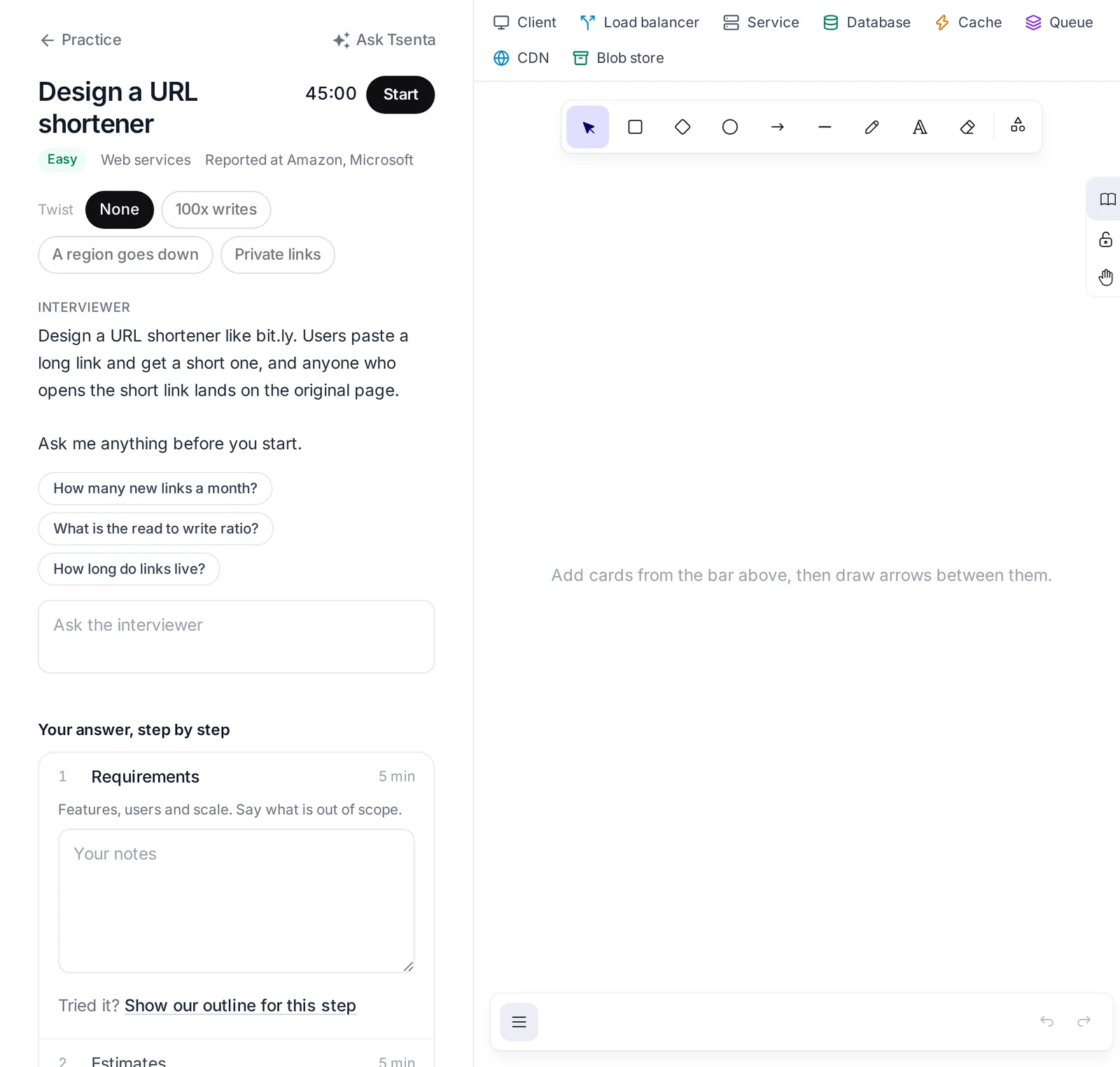
If your role has a design round, practice it in Tsenta's System design section, which Tsenta shows to people in tech roles. It has two parts. Learn is a course that grows one product from a single server to many regions, one real problem at a time. Practice has 100 classic prompts, such as a URL shortener or a chat app, each in a 45-minute workspace with optional twists like a region going down. At the end you see Tsenta's reference design next to your board and check yourself against a 6 to 10 point rubric.
- Microsoft Careers, Technical interviewing, checked November 15, 2026
- Microsoft Careers, Interview tips for all roles, checked November 15, 2026
- Microsoft Careers, How we hire (including the Candidate Code of Conduct), checked November 15, 2026
- Microsoft Careers, Virtual interviewing, checked November 15, 2026
- Microsoft, About (corporate values), checked November 15, 2026
- Microsoft Careers, Culture (cultural attributes), checked November 15, 2026
More interview practice in Tsenta
- CodingCoding interview practice3,400+ problems from 650+ companies' question lists, in eight languages plus SQL, with hidden tests, editorials and a debugger in every one of the eight languages.See coding practice
- Mock interviewAI mock interviewAn AI practice interviewer built from your real interview, answered out loud or typed, with a report that scores every answer and marks missing STAR parts.See mock interviews
- CompanyGoogle coding interviewWhat Google publishes about its interviews, what the questions on its lists test, and how to practice for a Google round in Tsenta.See the Google page
- CompanyAmazon coding interviewWhat Amazon publishes about its interviews, what the questions on its lists test, and how to practice for an Amazon round in Tsenta.See the Amazon page
Microsoft interview questions, answered
Prepare for your Microsoft interview, round by round
Connect your job email, and Tsenta finds your Microsoft interview, builds a mock for that round and, for a technical round in a software engineering or data science role, points you to Microsoft's coding questions.