
Amazon coding interview questions: what they test and how to practice
On public, community-kept lists, the 2,100+ coding interview questions linked to Amazon are mostly medium-difficulty data structure and algorithm problems (54% medium, 19% hard), most often on arrays, strings and hash maps. Amazon's own SDE II interview prep page asks for syntactically correct code, no pseudo code, and names scalable, robust and well-tested code as the main evaluation criteria.
Tsenta's Interview prep, in Beta, finds your Amazon interview in your job email and builds a mock of that round from your résumé and Amazon's published Leadership Principles. For a technical round in a software engineering or data science role, it also opens the coding questions on Amazon's list in an editor with hidden tests. After the real round, it scores your answers from a transcript or a written recap, and it does not join, listen to or record the interview itself.
- 2,100+
- questions linked to Amazon on public, community-kept lists
- 98%+
- of them open in Tsenta's editor with hidden tests
- 596
- questions the lists mark as asked in the last 30 days or three months
- 19%
- hard, against 23% across Tsenta's coding bank
Amazon mock interview and coding practice in Tsenta
- Step 1
My interviews finds it
Connect your job email and Tsenta reads your Amazon interview from it: the role, the round and when. You can also add it by hand. The card offers a Mock interview built for that round. For a technical round in a software engineering or data science role, it also has a Coding questions button for Amazon's list.
- Step 2
Next up says what to do first
When your Amazon technical round is your next interview, Next up at the top of My interviews names it with Practice it now. If the role is in software engineering or data science, a link to Amazon's coding questions sits beside it.
- Step 3
Work Amazon's list in Coding
Open Coding's Companies view, where the companies of your upcoming interviews are pinned first, or pick the Amazon chip in Problems. Amazon's list is sorted by how often each question is asked, with recent ones marked, and Submit runs every case, hidden tests included.
- Step 4
Rehearse a round in a mock interview
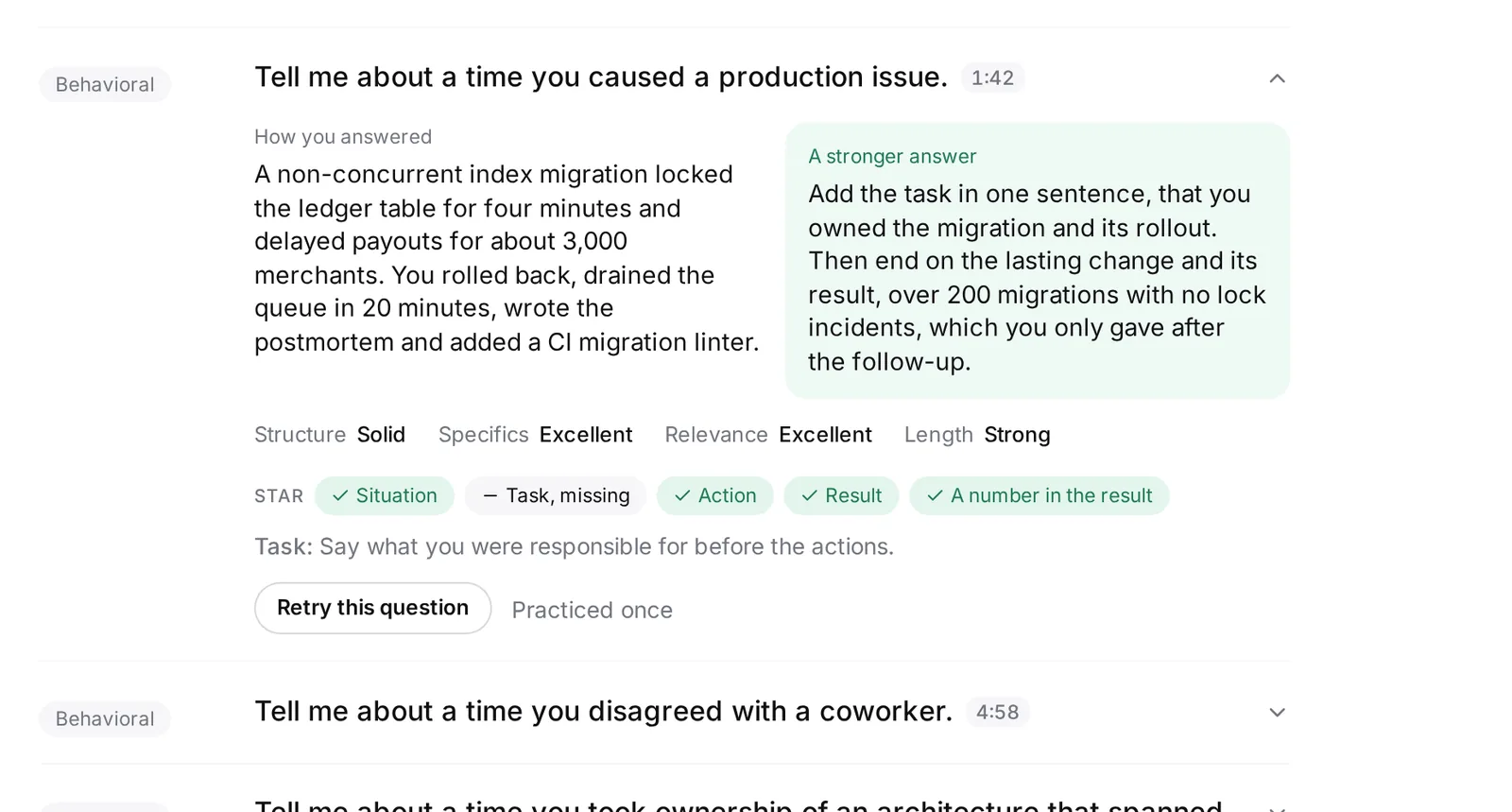
Press Mock interview on the card. The mock is built from your résumé, your saved stories, Amazon's published Leadership Principles and the job description when Tsenta has it for the posting. Its report scores every answer and, on behavioral answers, marks the STAR parts you gave and missed.
- Step 5
Get feedback after the real round
Add a transcript you have, or a written recap labeled Interviewer and Me. Tsenta scores each answer, lists what to prepare before your next round, and Practice the next round builds a mock interview around that feedback.
Amazon software engineer interview process: the OA, the loop and the Bar Raiser
Amazon's SDE II interview prep page lays out four steps: the job application, an online assessment, an interview loop and an interview outcome within 5 business days. The assessment opens with 90 minutes for two technical questions, followed by systems design scenarios and a multiple choice Work Style Survey related to the Leadership Principles. Amazon's SDE II online assessment prep page says only the coding part is timed, suggests reserving two hours and gives you seven days from the date the link was sent. The loop is four 55-minute interviews with members of Amazon's software development community.
In place of the assessment, Amazon's SDE III page lists a 60-minute technical phone screen with a senior leader, half on Leadership Principles and half on coding and system design. It then lists a loop of five 55-minute interviews. Amazon's interview loop page says you will likely meet two to seven people, which may include a Bar Raiser, someone from another team focused on hiring quality. Amazon also says it does not ask brain teasers.
What Amazon grades in the software engineer coding interview
Amazon's SDE II page is direct: expect to be asked to write "syntactically correct code" with no pseudo code. It names scalable, robust and well-tested code as the main evaluation criteria and asks you to check edge cases so no bad input slips through. It also says you will be asked for time and space complexity in almost all your interview questions. The page tells SDE II candidates to be prepared for three separate interviews evaluating logical and maintainable code, problem-solving, and data structures and algorithms.
For the online assessment, Amazon says the 90-minute timer does not stop even if you exit, your code must compile for every question to move forward, and efficiency earns more points than brute force. Its topics page recommends practicing coding outside of an integrated development environment and links a sample coding challenge you can click through as many times as you like. No specific language is required, and the assessment's list includes Python, Java, C++, C#, Go and JavaScript, six of the eight languages Tsenta runs.
- Logical and maintainable
- Names for variables, methods and classes that a future developer can follow, and functionality split into discrete methods with clear responsibilities.
- Problem-solving
- An ambiguous problem statement you clarify with questions, a first pass that covers every requirement, then an enhanced solution that shows how it evolves when requirements change.
- Data structures and algorithms
- Runtimes and memory use of trees, hash maps, lists, arrays and queues, and trade-offs such as breadth-first versus depth-first search.
Amazon coding interview questions by topic and difficulty
Tsenta's coding bank links 2,100+ questions to Amazon from public, community-kept lists of the questions companies ask. All time, they are 27% easy, 54% medium and 19% hard, against 24%, 53% and 23% across Tsenta's coding bank of 3,400+ questions. The 596 in the lists' recent windows (30 days or three months, as of snapshots from August and October 2026) are 28% easy, 56% medium and 16% hard.
By topic, Amazon's list looks like the bank as a whole: arrays are 56% of its questions, strings 22% and hash maps 22%, each within a point of the bank. The differences are a few points at most, and two are algorithms Amazon's prep page names. Depth-first search problems are 11% of Amazon's list against 9% across the bank, and breadth-first search 8% against 7%. Among recent questions, two pointers problems are 10% against 7%, sliding window 7% against 4% and linked lists 6% against 2%.
On these lists, 369 of Amazon's questions (18%) are also on the lists of 10 or more other companies, and 184 are on no other company's list. SQL problems are 5% of Amazon's list, the same as the bank. No list predicts your exact questions, so use these shares to choose what to drill, not as a forecast.
AI tools in the Amazon interview: what Amazon has said
Amazon's SDE interview prep pages on amazon.jobs, checked November 15, 2026, do not publish a rule on using outside AI tools during the assessment or the loop. Amazon's newsroom adds one related change. In January 2026, About Amazon said it had reimagined its technical assessments so candidates "work with an interactive AI assistant on a real coding platform," because its engineers use generative AI tools in their work. Do not assume outside AI tools are allowed: ask your recruiter what your assessment and loop allow, and use only the tools Amazon gives you.
Tsenta's own AI is built for practice before the interview and feedback after it, and Tsenta does not join, listen to or record your interviews. On a coding problem, the Tsenta assistant in the dashboard sidebar reads the problem, your code and your last run, gives hints before answers, and shows a full solution only when you ask. After the real round, Feedback reads a transcript or recap you add, and only you can see it.
Amazon Leadership Principles interview practice with STAR
Amazon's SDE II page says a significant portion of the conversation will focus on how you have shown its Leadership Principles in past jobs. It says each interviewer will typically ask two or three behavioral questions. It asks for metrics or data where applicable and answers framed with the STAR method, and its interview loop page adds that it helps to use "I" instead of "we." Amazon lists 16 principles, opening with Customer Obsession, then Ownership, and closing with Strive to be Earth's Best Employer, then Success and Scale Bring Broad Responsibility.
Tsenta builds an Amazon mock from your résumé, your saved stories and a short summary of each of Amazon's Leadership Principles, plus the job description when Tsenta has it for the posting. It asks one question at a time, follows up when an answer is missing your own action, a result or a number, and never invents facts about Amazon. On behavioral answers, the report marks each STAR part as given, given after a follow-up, or missing, with a tip for each missing part. It also names a story of yours that fits the question better.
Amazon asks for examples of times you took risks, succeeded, failed and grew. Save them in Your stories, Tsenta's STAR story bank, and the mock interviewer will know their titles and favor questions they can answer. A mock of an onsite or final round is 7 questions in about 45 minutes with 2 or 3 fictional panelists, and a technical round is 6 in about 40.
Amazon system design interview prep
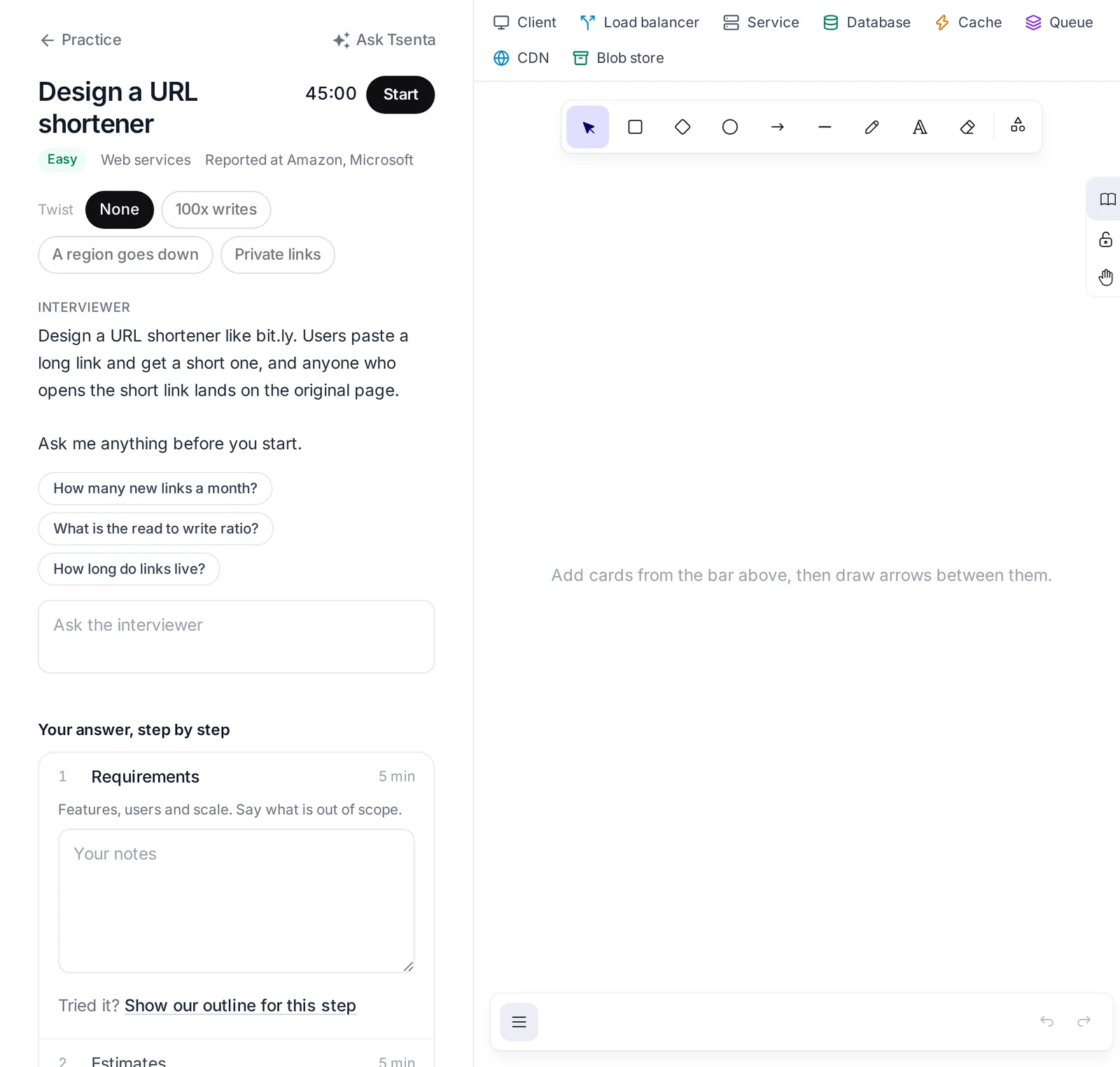
Amazon tells SDE II and SDE III candidates to expect at least one question on software systems design in the loop, and to ask questions to complete and validate the design. Its prep page suggests researching caching, load balancing, non-relational databases, microservices and sharding, and treating the interviewer as a customer whose vague requirements you clarify. The online assessment's design part is different: you rate how effective actions are in fictional scenarios, with no whiteboard or diagram.
In Tsenta, System design has Learn, a course that grows one product from a single server to many regions, and Practice, a library of 100 classic prompts. Filter Practice to Amazon for the prompts a source ties to Amazon, and work one in a 45-minute workspace with a whiteboard. Your clarifying questions get the numbers a candidate should ask for, and afterward you check your board yourself against Tsenta's reference design and a 6 to 10 point rubric. Tsenta shows Coding and System design to people in tech roles, based on the roles you search for and apply to, your interviews and your résumé.
- Amazon Jobs: SDE II Interview Prep, checked November 15, 2026
- Amazon Jobs: Online Assessment Prep, Software Development Engineer II, checked November 15, 2026
- Amazon Jobs: SDE III Interview Prep, checked November 15, 2026
- Amazon Jobs: Software development interview topics, checked November 15, 2026
- Amazon Jobs: Interview loop, checked November 15, 2026
- Amazon Jobs: Leadership Principles, checked November 15, 2026
- About Amazon: How 3 AI innovations are creating a better experience for candidates in Amazon's hiring process, checked November 15, 2026
More interview prep in Tsenta
- Coding interview practice3,400+ problems from 650+ companies' question lists, in eight languages plus SQL, with hidden tests and a line-by-line debugger in every one of the eight languages.See coding practice
- AI mock interviewA practice interviewer built from your real interview, answered out loud or typed, with scores on every answer and STAR feedback on behavioral ones.See mock interviews
- Google coding interviewWhat Google's hiring page says about rubrics and AI tools, and what the 2,400+ questions on its list test.See the Google page
- Meta coding interviewWhat the 1,400+ questions on Meta's list test, where only 10% of the recent ones are hard.See the Meta page
Questions about the Amazon SDE interview
Practice the Amazon round you actually have
Connect your job email and Tsenta finds the interview, then offers a mock built for that round and, for a technical round in a software engineering or data science role, Amazon's coding questions.