
Uber coding interview questions: what they test and how to practice
The 370+ Uber coding interview questions on public, community-kept lists lean toward graphs and harder problems: 29% are hard and 18% involve breadth-first search, against 23% and 7% across Tsenta's coding bank. Tsenta's Interview tab, in Beta on the web, opens about 98% of Uber's question list in its own editor, builds a mock of your real Uber round and gives feedback after it.
Uber's Backend Engineering Interview Guide lays out the loop for each level from L3 to L6+. Interviews typically run 60 minutes each, on algorithms and data structures, depth in your specialization, design and architecture, and collaboration and leadership. The guide says AI tools aren't allowed during interviews unless your recruiter tells you otherwise, so use Tsenta before your Uber round and after it, not in it.
- 370+
- questions on Uber's list in Tsenta's coding bank, about 98% of them open in its editor
- 29%
- hard on Uber's list, against 23% across the bank
- 18%
- breadth-first search on Uber's list, against 7% across the bank
- 8%
- union-find on Uber's list, against 3% across the bank
How to practice for your Uber interview in Tsenta
- Step 1
Tsenta finds the interview
My interviews reads your upcoming Uber interview from the job email you connect to Tsenta, with the role, round and day. You can also add it by hand.
- Step 2
Next up points at Uber's questions
When your Uber technical round is the soonest one coming up, Next up says when it is, with Practice it now and a link to Uber's coding questions. That link and the card's Coding questions button appear only for a technical round of a software engineering or data science role, or of a user Tsenta counts as tech. Tsenta shows Coding and System design to people in tech roles, based on the roles you search for and apply to, your interviews and your résumé.
- Step 3
Work Uber's list in Coding
With an Uber interview coming up, Coding's Companies view pins Uber at the top with the other companies you are interviewing with. Uber's list there starts with the questions asked most often and marks the ones asked recently. To drill graphs, pick the Uber chip in Problems and add a pattern filter such as breadth-first search.
- Step 4
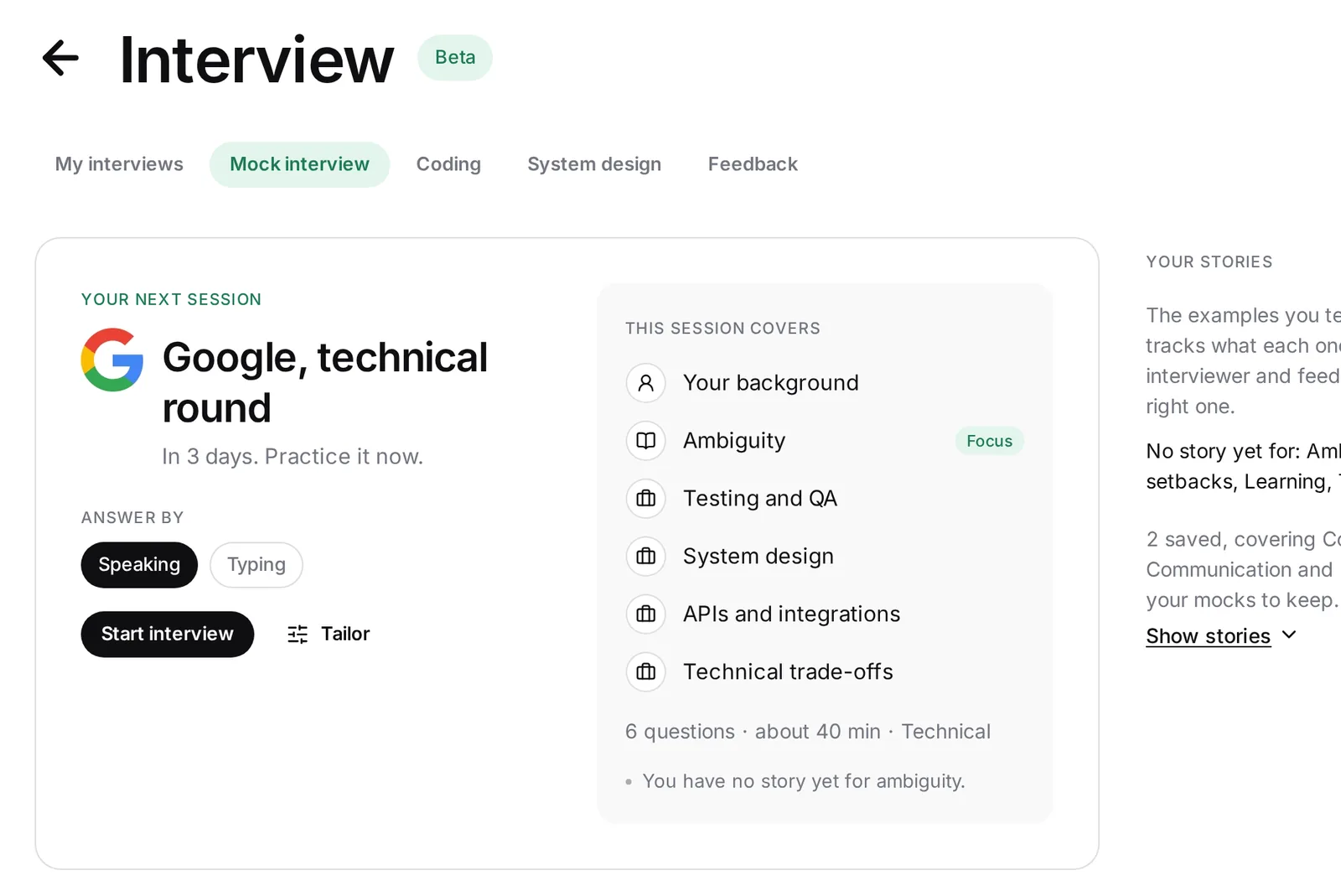
Rehearse the round with a mock
Press Mock interview on the interview's card for a mock of that round, answered by typing or speaking. It draws on your résumé, your stories and Uber's published values, plus the job description when Tsenta has it for the posting. Pair a technical round's mock with Uber's list in Coding. If your level has a Design and Architecture round, also work a prompt in System design.
- Step 5
Get feedback on the real round
After the round, press Add transcript on the interview's card and paste a recap you type from memory, with at least six turns labeled Interviewer and Me, for feedback on each answer. Prep for the next round then sets up a mock of your next Uber round, built around that feedback.
Uber software engineer interview process, in Uber's words
Uber's Get interview ready page links an Engineering Interview Guide, with separate guides for backend, frontend, Android, iOS, data and other domains. It says the process “is consistent across engineering roles, but each domain focuses on different technical expertise.” The Backend Engineering Interview Guide, the one quoted here, lays out the process for each level: L3, L4, L5A, L5B and L6+. It says steps can vary with the role, location and business needs, and that your recruiter has the most accurate details.
The guide calls each stage “a decision point,” where the team decides whether to move you forward. Its FAQ says interviews are typically 60 minutes each, and the guide names the competencies it assesses: Software Engineering, Design and Architecture, and Collaboration and Leadership. After the last round, your recruiter meets with the panel to review your performance “against the role's competencies and our values.” Uber says recruiters typically follow up within 2 to 3 business days after each interview.
- Recruiter or sourcer call
- Virtual, 30 minutes, about the role and your experience. Uber's guide says to have your elevator pitch ready and to know why you want Uber.
- Online assessment, or OA (L3 and L4)
- Done on your own time, focused on data structures and algorithms, in the platform's built-in editor. Uber says external IDEs are not allowed and that performance is evaluated on correctness, speed, implementation quality and problem-solving ability.
- Technical phone screen
- Online, 60 minutes of pair programming: about 45 minutes of coding and about 15 on design and architecture, where you discuss a past project. Uber says this screen sets the initial level you move forward at. At L6+ it becomes two screens, one with a hiring manager on scope and impact and one on technical architecture.
- Coding 1: algorithms and data structures
- 60 minutes on problems that are “generic and not tied to a specific technical domain.” You are expected to “write testable code and clearly identify what you would test.”
- Coding 2: depth in specialization
- 60 minutes on a problem like those in the role, such as a change to a project Uber provides or something built from scratch. The interviewer focuses on how you would take your code to production.
- Design and architecture (L4 and up)
- A new problem on a whiteboard, and from L5A also a previously solved problem, where you walk through the architecture of a project you worked on and the trade-offs behind it.
- Collaboration and leadership
- Working within and across teams, handling conflict, stakeholders and mentoring, answered in STAR form. The L5B and L6+ loops add impact, efficiency and quality.
Uber technical interview questions: topics and difficulty
Uber's guide gives only five example technical questions, covering arrays, 2D arrays, sorting, strings, dynamic programming, two pointers and search. Tsenta's coding bank links 370+ questions to Uber from public, community-kept lists of the questions companies ask, and Uber's list is harder and more graph-heavy than the bank as a whole. Of its questions, 29% are hard, 59% medium and 12% easy, against 23%, 53% and 24% across the bank.
Graphs are where Uber's list stands out most. Graph problems are 12% of it against 5% across the bank, and matrix problems 13% against 7%. Breadth-first search is its most common technique, at 18% against 7%, with depth-first search at 17% against 9% and union-find at 8% against 3%.
The study list in Uber's guide does name graphs: it asks you to review graphs with depth-first and breadth-first search, and to study sorting, binary search and tree operations. On Uber's list, binary search is 13% against 9% across the bank, while greedy problems fall to 8% from the bank's 12%. Only 31 of Uber's questions are marked as asked in the last 30 days or three months, as of snapshots from August and October 2026. That is too few to read a trend from, so every share here is all time.
- Common topics
- Arrays 64%, hash maps 26%, strings 24% and heaps 11%, against 56%, 22%, 23% and 6% across the bank.
- Other common techniques
- Dynamic programming 17%, the same as across the bank, and sorting 15% against 14%.
- SQL
- 1% of Uber's list, against 5% across the bank.
- Overlap with other companies
- 20 of Uber's questions are on no other company's list, while 188, half of Uber's list, are also on the lists of 10 or more other companies.
How to prepare for an Uber coding interview
Uber's guide leaves the language to you: “Your choice. Choose your language wisely and ensure you're highly proficient in it.” It says Uber is “not evaluating your knowledge of specific programming languages, but rather your ability to solve problems with the tools in your toolkit.” It lists vectors, lists, hash maps, trees, linked lists, stacks, queues, heaps and graphs to review, and asks you to know Big-O for time and space.
During the coding rounds, the guide asks you to clarify the problem first and discuss your approach before you implement it. It also asks you to account for edge cases, keep the solution simple, write readable code with meaningful names, and test and debug as you go. For the online assessment, it suggests solving simpler problems first to secure correct answers and pacing yourself against the timer.
In Tsenta, Run checks your code against the examples and Submit runs every case, hidden tests included, in Python, JavaScript, TypeScript, Java, C++, C#, Go or Rust. Debug steps through one example's run line by line in any of them, forward and back, with breakpoints, the variables and the call stack. That gives you practice at the testing and debugging Uber's guide asks for. The Solution tab keeps Tsenta's editorial and a reference solution behind one “Show solution,” and the sidebar assistant gives hints before answers.
Uber behavioral interview: values, competencies and STAR
Uber's guide says hiring teams “assess every candidate with our values in mind” and asks you to prepare examples of how you have used them to make decisions. Its sample value questions include “Tell me about a project that innovated how you...” for Trip obsessed and “Describe how you work across teams to...” for One Uber. It asks for STAR answers (situation, task, action, results), at least 1 to 2 examples of past projects for each competency, and no hypothetical situations.
The guide also lists the success attributes Uber looks for: adaptability, bias towards action, collaboration, grit, interpersonal influence, inquisitiveness and being entrepreneurial. Tsenta's mock interviewer reads Uber's eight published values, summarized below from Uber's 2026 governance report, and favors questions your saved stories can answer. Because Uber asks for real past projects in STAR form, the mock's report checks each behavioral answer for situation, task, action, result and a number in the result. It notes which parts you gave only after a follow-up and adds a tip for each part you left out.
- Go get it
- Bring the mindset of a champion: hustle, overcome adversity and play to win, especially on the worst days.
- Trip obsessed
- Make magic in the marketplace: balance every side, make hard trade-offs and create simplicity from complexity.
- Build with heart
- Put yourself in the shoes of the people on the platform, and perfect your craft.
- Stand for safety
- Safety never stops. Embed safety into everything you do.
- See the forest and the trees
- See the big picture and know the details that matter. Small improvements compound.
- One Uber
- Bet on something bigger: do what's best for Uber, support teammates, say what you mean, disagree and commit.
- Great minds don't think alike
- Diversity of ideas, identity, background and experience leads to better decisions.
- Do the right thing. Period.
- Act with integrity, always.
Uber mock interview and system design practice
Tsenta's four mock round types map onto the conversations in Uber's loop, not the code. A recruiter screen is 5 questions in about 25 minutes, for Uber's 30-minute recruiter call, and a hiring manager mock is 6 in about 40, a fit for the Collaboration and Leadership round. A technical round mock, also 6 in about 40, covers topics such as your background, systems and the languages you use, so pair it with Uber's list in Coding for the code itself. A panel or onsite mock is 7 questions in about 45 minutes with 2 or 3 fictional panelists.
Tailor changes up to 3 focus areas, the length, the interviewer and the level. The interviewer asks one question at a time and follows up when an answer is missing your own action, a result or a number. It never hints whether you would pass, and the report arrives shortly after you end.
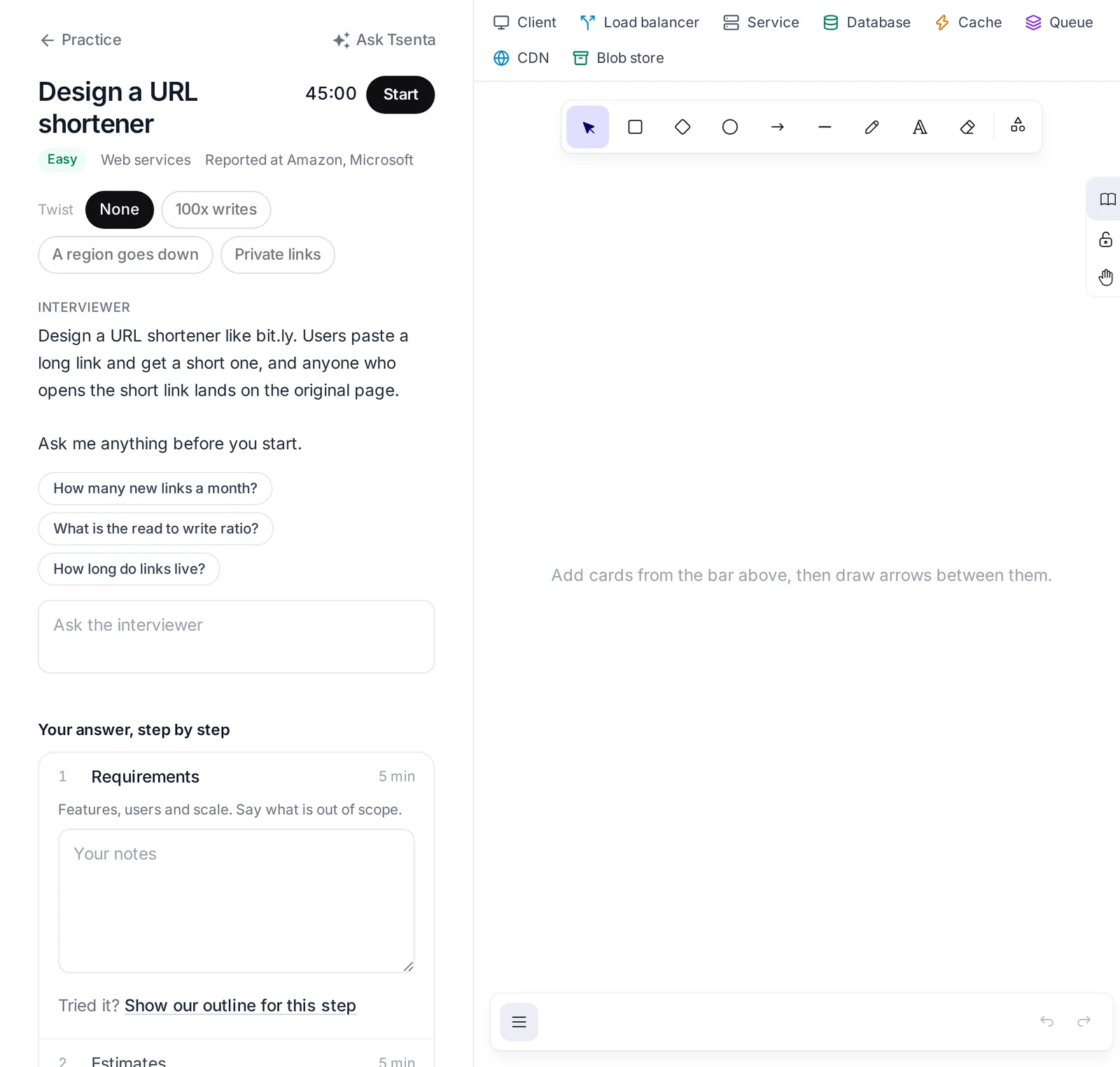
From L4, Uber's loop adds a Design and Architecture whiteboard round, where you “build the high-level architecture for a large-scale application” and weigh trade-offs such as consistency versus latency and SQL versus NoSQL. In Tsenta, System design is its own section for people in tech roles, and its Practice has 100 classic prompts, such as a URL shortener, a news feed and a chat app. Each opens a 45-minute workspace with an interviewer that answers your clarifying questions with the numbers a candidate should ask for, optional twists like a region going down, and a whiteboard. The review shows Tsenta's reference design beside your board, with a 6 to 10 point rubric you check yourself against.
Uber's rule on AI tools in interviews, and where Tsenta fits
Uber's guide states its rule on AI plainly: “Unless your recruiter specifically tells you otherwise, AI tools aren't allowed during interviews.” It names AI chat tools, automated response generators and code auto-completion programs as examples, and explains, “We want to understand your own skills, problem-solving approach, and thought process in real time.” It adds that in some technical interviews “you may be provided with an AI agent as part of the coding environment,” in which case your recruiter tells you ahead of time.
Tsenta is not a live interview assistant, and it is built for practice before the round and feedback after it. It does not join, listen to or record your interviews, and its assistant's hints are meant for the problems you practice in Tsenta. An AI notetaker is an AI tool too, so leave it off in an Uber round unless your recruiter says otherwise, and type a recap from memory afterward. The feedback on that recap is visible only to you and scores each answer on structure, specifics, relevance and length, with a stronger way to say it.
- Uber Careers, Get interview ready, checked November 15, 2026
- Uber Careers, Engineering Interview Guides, checked November 15, 2026
- Uber Careers, Backend Engineering Interview Guide, checked November 15, 2026
- Uber, 2026 Governance Strategy and Engagement Report (Our values), checked November 15, 2026
More ways to prepare
- CodingCoding interview practice3,400+ problems from 650+ companies' lists, in eight languages plus SQL, with hidden tests, a debugger in every one of the eight languages and Tsenta's own editorials.See coding practice
- Mock interviewAI mock interviewA practice round built from your real interview, answered out loud or typed, with a report that scores every answer and marks the STAR parts.See mock interviews
- CompanyGoogle coding interviewWhat Google publishes about its hiring process and its rule on AI, and what the questions on its list test against Tsenta's coding bank.Read the Google page
- CompanyMeta coding interviewWhat Meta publishes about its interviews, and how the questions on its list compare with Tsenta's coding bank.Read the Meta page
Uber coding interview questions, answered
Get ready for the Uber round you have next
Connect your job email, and the agent that applies for you finds your Uber interview, builds a mock of that round and, after it, gives feedback on your transcript or recap.