

Tsenta vs Huntr, $40 to track, $39 to actually apply
Huntr Pro is $40/mo for a kanban tracker. Tsenta Pro is $39/mo for 1,500 actual applications and a tracker. same price ballpark, two completely different shapes of product.
huntr is a kanban board with a $40/mo subscription.
that's the whole product. drag a job card from "wishlist" to "applied" to "interview" to "offer." it's tracking software for the applications you already sent.
if dragging cards is the thing you're paying for, $40/mo is a wild number.
what huntr actually is
huntr is the most well-known application tracker in the job-search space. you save jobs from any board (chrome extension to clip them), you organize them on a kanban-style board, you log notes, you track interview stages, you set follow-up reminders. there's also an autofill side, where the extension will fill in basic fields when you go to apply.
honestly, as a tracker, it's good. the UX is clean, the workflow makes sense, and if you're someone who likes seeing your job hunt visually organized, huntr nails it. they've been around for years and they earned their reputation.
paid is $40/mo or $30/mo if you pay quarterly ($90), or $26.66/mo if you commit for six months ($160). Huntr Pro unlocks more tracked jobs, more autofill, more AI features. it does not, anywhere, apply to jobs for you. that part is still on you.
the autofill vs apply gap
picture the actual workflow. you find a job on linkedin. you clip it into huntr with the extension. now it's a card on your board. then you have to actually apply, which means opening the job posting, clicking through to the application, letting the extension fill what it can, finishing the rest yourself, submitting, then dragging the huntr card from "saved" to "applied."
huntr is helping you stay organized about a process you're still doing by hand. the tracker is the receipts. it's not the work.
with tsenta, you queue jobs and they get applied to. you don't drag a card to "applied", it gets moved automatically once the application actually goes out. and the application going out doesn't require you to do anything.
also worth saying: tsenta has a built-in tracker. you get the kanban-style view, the application status, the interview tracking, the inbox where recruiter emails land and get tagged. you're not picking between "apply tool" and "tracker." you're getting both, in one product, for less than half what huntr alone costs.
where tsenta is different
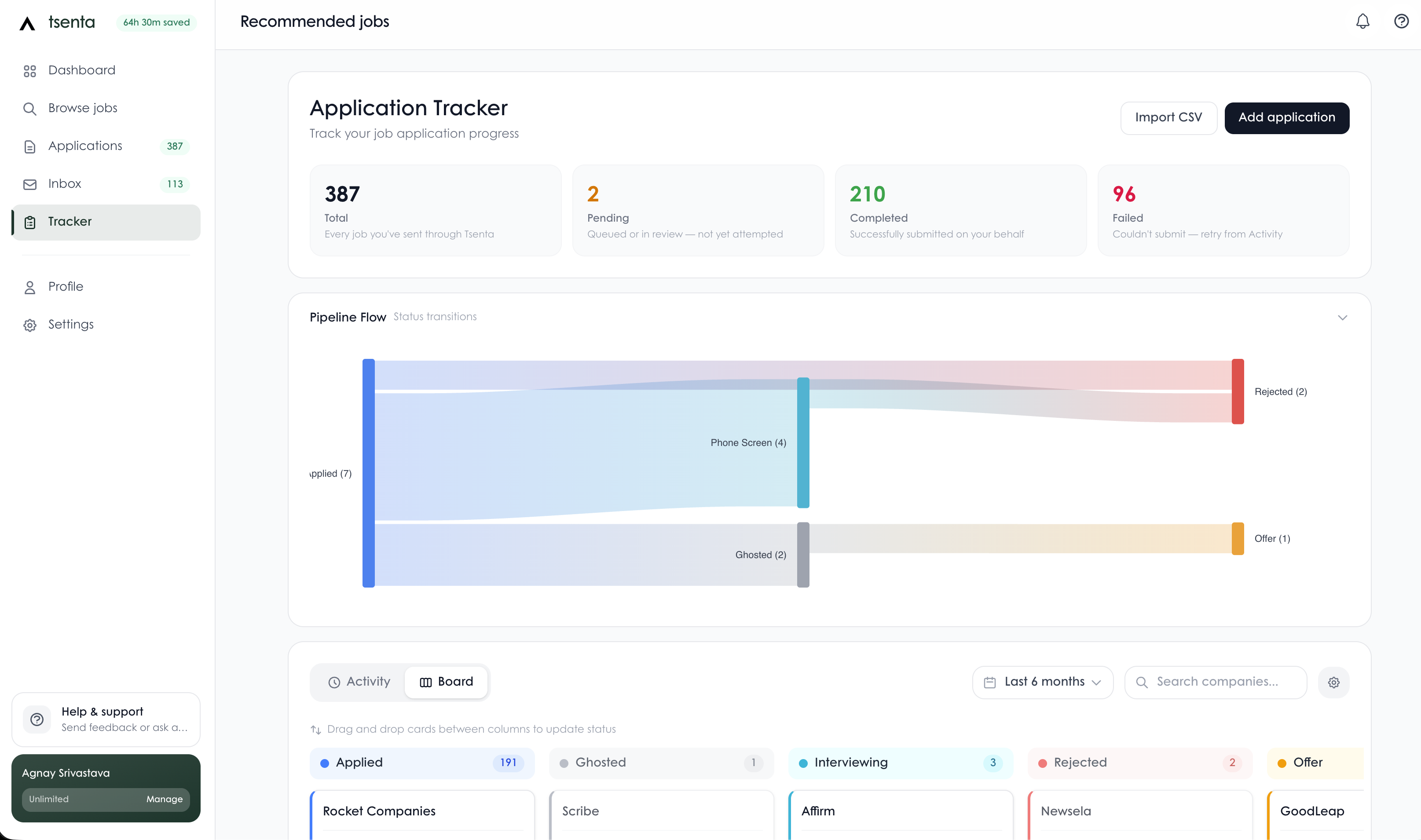
a few specific things if you're comparing:
-
it actually applies. tsenta runs end-to-end applications in the cloud while you do whatever else with your day. huntr requires you to click submit on every single job.
-
built-in tracker. you don't need a separate $40/mo subscription to a kanban board. tsenta tracks every application it submits, plus any you add manually, plus the inbox where the responses come in.
-
7 surfaces to apply from. web dashboard, Android and iOS apps, Chrome extension, MCP for Claude and ChatGPT, iMessage bot, WhatsApp bot. huntr is web + chrome extension.
-
same price ballpark, different product. tsenta pro is $39/mo for 1,500 actual applications a month, plus the tracker. huntr pro is $40/mo for the tracker alone. if your volume is lower, tsenta starter at $19/mo covers 600 applications and still includes the tracker, which is half what huntr charges.
-
free tier to try before paying. 25 applications, full Pro features, no time limit. huntr has a free tier too, but theirs is the tracker. ours is actual applications submitted for you.
the comparison
| Feature | Huntr Pro | Tsenta |
|---|---|---|
| Free tier | yes, limited tracking | 25 apps total, no time limit, full Pro features |
| Entry monthly | $40 | $19 (Starter, 600 apps/mo) |
| Standard monthly | $40 | $39 (Pro, 1,500 apps/mo) |
| Higher tier monthly | n/a | $99 (Power, 4,500 apps/mo) |
| Quarterly | $90 ($30/mo) | up to 32% off |
| Six-month | $160 ($26.66/mo) | n/a |
| Annual | annual discount | up to 36% off |
| One-time credit packs | none | $19 / $39 / $99 (200, 600, 2,000 credits, never expire) |
| Actually applies for you | no | yes, end-to-end |
| Application tracker | yes, the core product | yes, built in |
| Kanban board UX | strong, mature | yes, simpler |
| Inbox / recruiter messages | no | yes |
| Resume editor | yes | yes |
| AI resume optimization | yes | yes (included every tier) |
| Automated OTP filling | no | yes (included every tier) |
| Where it runs | browser | the cloud |
| ATS coverage | autofills most | submits on Workday, Greenhouse, Ashby, SmartRecruiters, Lever, iCIMS, Oracle Cloud, Workable, Paylocity, JazzHR, BambooHR, Jobvite, Rippling, BreezyHR, UltiPro |
| Surfaces | web + chrome extension | Web, Android, iOS, Chrome ext, MCP, iMessage, WhatsApp |
| MCP for Claude/ChatGPT | no | yes |
| iMessage / WhatsApp apply | no | yes |
| Priority support | varies | yes (included every tier) |
the closer
huntr is a good tracker. that part is honest. but it's still a tracker, and tracker software is one component of what you actually need when you're applying to hundreds of jobs.
paying $40/mo for the tracker by itself, when $39/mo gets you a product that applies to 1,500 jobs a month and has a tracker built in, doesn't add up. and if you don't need that volume, tsenta starter is $19/mo for 600 applications, which is less than half what huntr charges to just organize your hand-typed applications.
we wrote a longer breakdown of all the cloud applier comparisons at /blog/tsenta-vs-competitors if you want the wider picture.
(if you want a tracker that's part of a tool that actually applies to jobs, that's us. try the 25 free apps. no card needed.)
Frequently asked questions
What is the main difference between Tsenta and Huntr?
Huntr Pro is $40/mo for a kanban tracker. Tsenta Pro is $39/mo for 1,500 actual applications and a tracker. same price ballpark, two completely different shapes of product.
Which is better for end-to-end job applications: Tsenta or Huntr?
Tsenta is built to complete supported applications end to end, including ATS navigation, tailored materials, submission, and tracking. Use the comparison above to decide whether that workflow or the competitor's strengths fit your search.
What should I compare before choosing Tsenta or Huntr?
Compare automation depth, ATS coverage, application limits, pricing, transparency, and whether the tool submits applications or only helps with part of the process.